Two world titles. And then, for the last seventeen years of his life, almost complete silence.
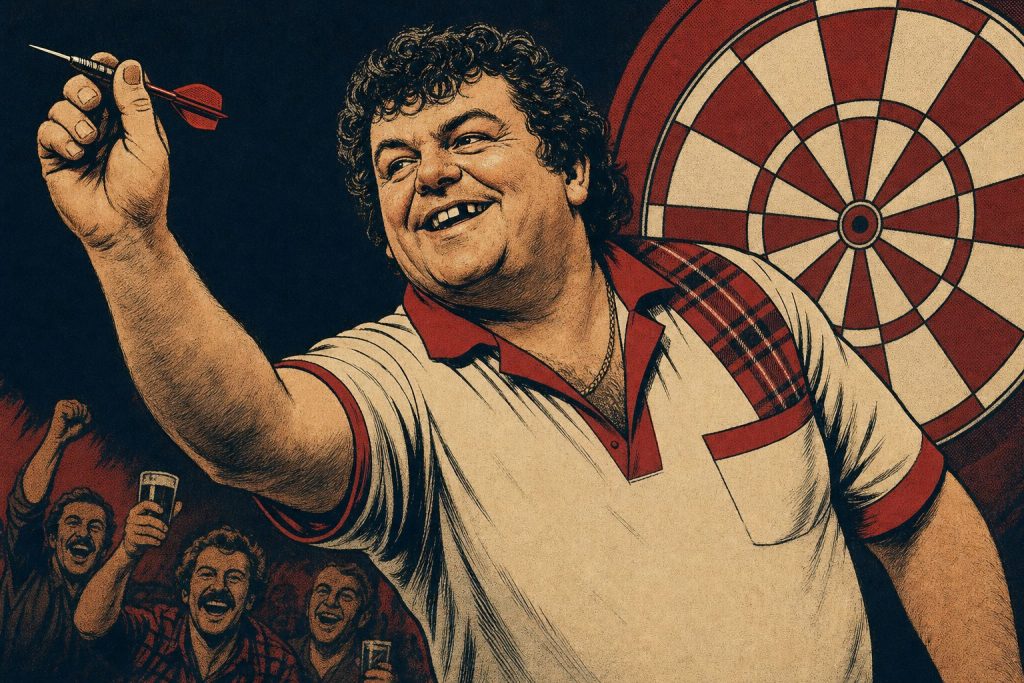
Jocky Wilson’s story is the one darts tells when it wants to remind itself what the 1980s were actually like. Not the polished version on the highlight reels, but the real thing: a Fife miner with no teeth and a fifty-a-day habit who beat everybody, twice, and then went home to Kirkcaldy and shut the door behind him.
From Kirkcaldy, the hard way
John Thomas Wilson was born in Kirkcaldy on 22 March 1950, and nothing about the start was gentle. He spent part of his childhood in an orphanage after his parents were judged unfit to care for him. He served in the British Army from 1966 to 1968, then worked as a coalman, a fish processor and a miner at Seafield Colliery. Darts was the pub game that turned out to be the way out: in 1979 he won £500 at a Butlins competition, and that was enough to tip him into the professional game.
He arrived with a physique built at the bar rather than the gym and a set of habits the modern game would not survive a week of. He had lost all his teeth by the age of 28, partly because he refused to brush them, on the grounds that he did not trust English water. He smoked, reportedly, more than fifty cigarettes a day, and kept it up for forty years. He drank the way that whole era drank, only more so. None of it stopped him throwing darts like very few people on earth.
1982: the people’s champion
In 1982 Wilson won the World Championship, beating John Lowe 5-3 in the final. Lowe was the metronome, the model professional. Wilson was everything else, and the contrast is part of why the win landed the way it did. Scotland had a world champion, and he looked and sounded exactly like the men who watched him.
With the winnings he paid £1,200 for a set of dentures. That is the kind of detail a scriptwriter would invent if it were not already true.
He was no one-tournament wonder either. Wilson won the British Professional Championship a record four times, in 1981, 1983, 1986 and 1988, and the British Matchplay in 1980 and 1981. He was twice a runner-up at the World Masters, in 1982 and 1990. And he had already announced himself in the team game: in the 1981 BDO Nations Cup final, Wilson, captain Rab Smith and Angus Ross beat an England side containing Eric Bristow and Cliff Lazarenko 5-4. Beating Bristow was about to become something of a theme.
1989, and the final he nearly threw away
The defence of his title ended in the 1983 semi-final, where he lost 5-3 to Keith Deller, the young qualifier who went on to win the whole thing. Through the rest of the decade the second title would not quite come. Then 1989.
The 1989 final against Eric Bristow is one of the most retold matches in the history of the championship, and it earns every retelling. Wilson led 5-0 in sets. One set from the title, against the most decorated player of the age, and he began to wobble. Bristow took the next four. 5-4, and every ounce of momentum in the room running one way. What happens to most players at that point is well documented, and it is not pleasant. Wilson steadied, found his darts again, and won 6-4. Seven years between world titles, and the second one hauled back from the edge of what would have been the most famous collapse darts had ever seen.
The split, and the fade
When the sport tore in two in 1993, Wilson went with the breakaway: he was one of the sixteen players who had founded the World Darts Council the year before, alongside the other big names of the era. It did not give him a second wind. He played in two PDC World Championships, in 1994 and 1995, and did not win a match in either. His last televised appearance came at the 1995 World Matchplay, a defeat to Nigel Justice. In December 1995 he was diagnosed with diabetes, and he retired.
There was no farewell tour. There was barely a farewell.
The vanishing
What followed is the part that darkens every retrospective. Wilson was declared bankrupt in 1998. He went back to Kirkcaldy and lived quietly on a council estate, refusing interviews, seeing almost nobody from the game that had made him famous. In November 2009 he was diagnosed with chronic obstructive pulmonary disease, the bill for four decades of cigarettes arriving all at once.
He died on 24 March 2012, two days after his 62nd birthday, in the town where he was born. Those who knew him away from the oche described a lovely, quiet, firm family man, which is not the character the cameras ever showed, and was probably closer to the truth than anything they did.
The two titles stand. So does the 1989 final, which gets no less remarkable with age. But the reason Jocky Wilson keeps being written about, decades on, is simpler than any of that: no sport has ever produced anyone quite like him, and darts, a game that has produced some characters, knows it.