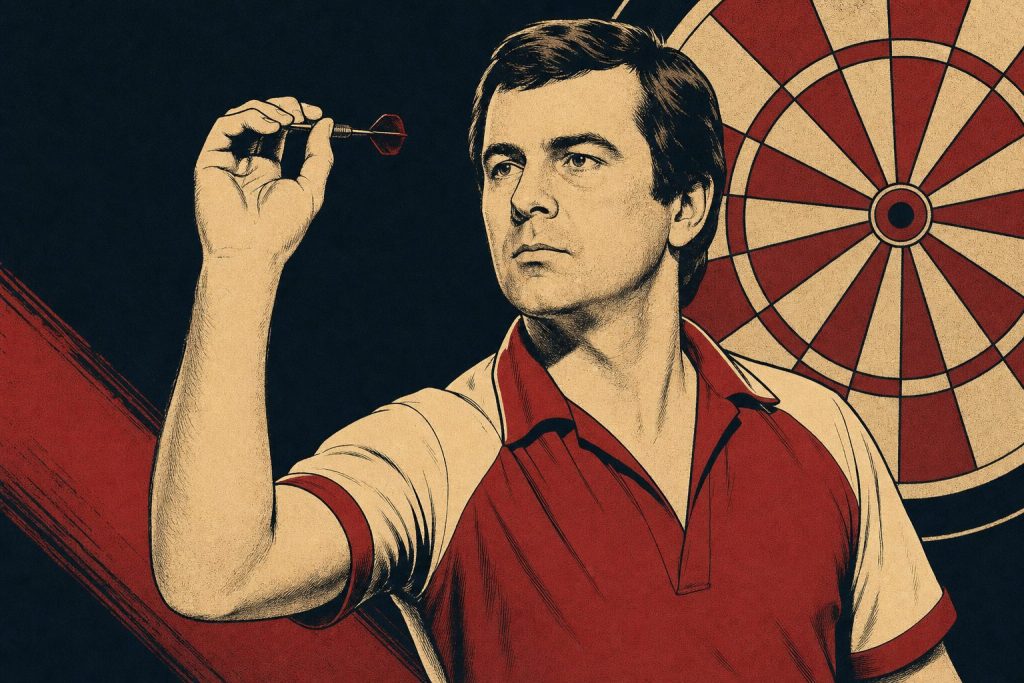
Three world titles. Three different decades.
Nobody had won the World Championship in three separate decades before John Lowe did it. 1979, 1987, 1993. The spread of those years tells you what kind of player he was. Not a comet, burning bright and briefly, but a constant. He appeared in the televised stages of the World Championship for 28 consecutive years, from the first tournament in 1978 to his final appearance in 2005, a record at the time and still one of the quietly staggering numbers in darts. Careers have started, peaked and finished, twice over, in less time than that.
Old Stoneface
Born on 21 July 1945 in New Tupton, Derbyshire, Lowe came to the game in 1966 and built a throw that coaches still point to: upright, economical, the same dart delivered the same way, tournament after tournament, for four decades. The nickname was Old Stoneface, and it was earned. While rivals scowled and strutted and worked the crowd, Lowe simply stood there and threw. Some read it as coldness. It was concentration, and it aged better than charisma ever does.
The trophies started before the World Championship even existed. He won the World Masters in 1976, and again in 1980. The News of the World Championship came in 1981, British Matchplay titles in 1978 and 1985. The British Pentathlon, darts’ all-round examination, he won ten times in all, including six consecutive years from 1982 to 1987. He held the world number one ranking on four separate occasions. Whatever the format, whatever the year, Lowe was there or thereabouts, which sounds like faint praise until you consider how many years that covers.
1979, and the finals that got away
Lowe reached the very first World Championship final in 1978 and lost it 11-7 to Leighton Rees, in the days when the final was decided by legs rather than sets. A year later he put that right in the most emphatic fashion available: 5-0 over Rees, and a first world title at 33.
Then came the losing finals, and there were plenty. He lost the 1981 final 5-3 to Eric Bristow. He lost the 1982 final 5-3 to Jocky Wilson. He lost the 1985 final 6-2 to Bristow again, and the 1988 final 6-4 to Bob Anderson. Five runner-up finishes at the World Championship would define most careers, and not kindly. For Lowe they were connective tissue between titles, the price of turning up every single January and nearly always being one of the last men standing.
The Bristow problem
Every great career has an obstacle, and Lowe’s was Eric Bristow. They met six times in World Championship semi-finals and finals, and Lowe’s overall record against him in the majors read three wins and six defeats. For most of the 1980s, the story of Lowe’s championship was the story of running into the Crafty Cockney somewhere near the end of the week, and usually coming off worse.
Which is what makes 1987 the emotional centre of his career. It was the fourth time Lowe had faced Bristow in a major final, and the first time he beat him: 6-4, for a second world title eight years after the first. There was no gloating in it, because gloating was never the Lowe way. Just a man who had kept turning up until the result changed.
Nine darts and £102,000
On 13 October 1984, at the World Matchplay, Lowe threw the first nine-dart finish ever seen on television. The opponent was Keith Deller, and Lowe closed out the perfect leg with treble 17, treble 18, double 18. The prize was £102,000.
The money is the detail worth sitting with. £102,000, in 1984, in a sport where a world title had recently been worth a few thousand pounds. One leg of darts, worth more than most players had earned in their careers to that point. It rewrote what the game thought it could pay, and it attached Lowe’s name permanently to a piece of history that has nothing to do with grinding consistency and everything to do with nine perfect darts thrown in a row, under lights, with a fortune on the line, by the man least likely to let you see what that pressure felt like.
1993, and the long view
The third title came in 1993, a 6-3 win over Alan Warriner, fourteen years after the first. Three championships across the seventies, the eighties and the nineties. He was the first man to manage it, and through the remainder of the BDO era nobody repeated it.
That same year the sport tore itself in half. Lowe was one of the sixteen players who had formed the World Darts Council the year before and now broke away behind it, the schism covered in full in the story of the 1993 split, and he went on to compete on the new circuit all the way to 2007. Even the breakaway, the most disruptive event in the sport’s history, could not interrupt his habit of simply carrying on.
The rest of the ledger reads like a second career all by itself. More than 100 appearances for England. The England captaincy from 1986 to 1993, during which the team went unbeaten. An autobiography, Old Stoneface, in 2005, a coaching book, The Art of Darts, in 2009, and an MBE in 2018 for services to a sport he had served longer than almost anyone alive.
Bristow had the swagger, Wilson had the chaos, Deller had the fairytale. Lowe had the longevity. And longevity, in the end, is the hardest trick in darts.