Somebody had to win it first.
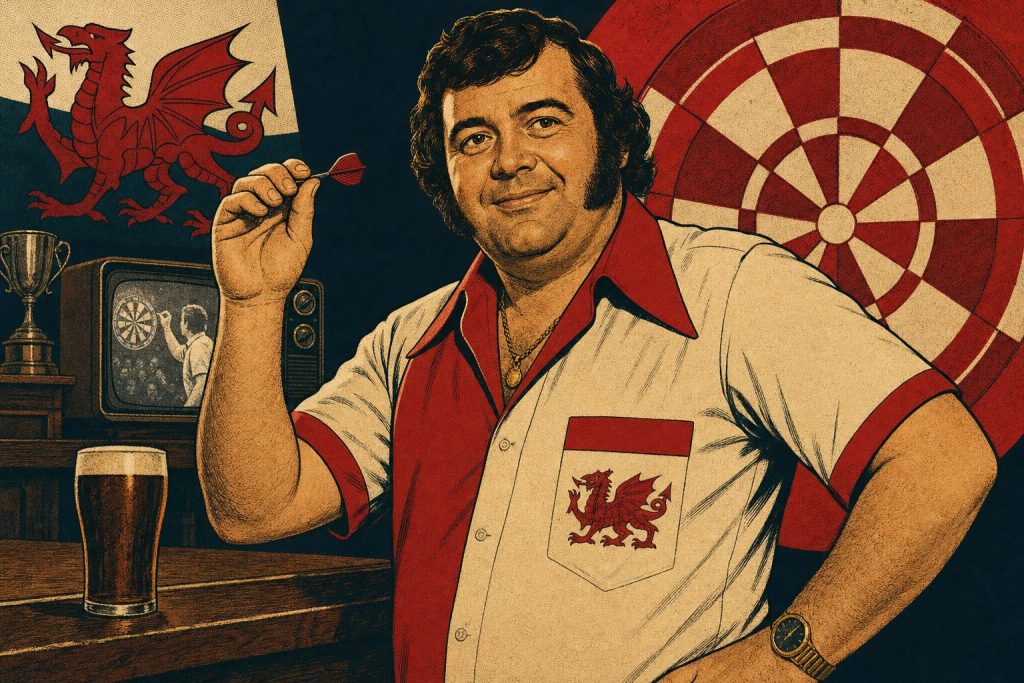
In 1978, in Nottingham, the Embassy World Professional Darts Championship was staged for the very first time. The tournament that would go on to fill the Lakeside stage every January for decades. The man who won it, and whose name therefore sits at the top of the roll of champions for as long as anyone keeps such lists, was a 38-year-old Welshman from a mining village: Leighton Rees.
The storeman from Ynysybwl
Rees was born on 17 January 1940 and grew up in Ynysybwl, in the Glamorgan valleys. There was nothing glamorous about the road in. He spent more than twenty years working in the storeroom of a motor spares company, and by 1970 he was throwing for his local pub and, before long, for Wales. Darts in that era was not a career; it was what serious men did to a fearsomely high standard in the evenings.
He did not turn professional until 1976, at 36: an age at which the modern game would consider a debutant a curiosity. Rees was no curiosity. By then he was already one of the most feared throwers in Britain, and the game was finally growing an economy capable of paying him for it.
Made for television
Television found darts in the 1970s, and it found Rees early. He won the Indoor League, the pioneering pub-games show, in 1974 and again in 1976, the only player ever to win it twice, and between throws he would chat with host Fred Trueman over a lager and a cigar, telling stories about himself and Alan Evans hustling the English. The cameras loved him for the same reason the crowds did: the dry humour, the total lack of pretence, and arenas that nearly always filled when he played.
The near-misses of that period mattered too. He reached the final of the 1976 News of the World Championship, then the biggest prize in the game, and lost to Bill Lennard. He took the Welsh Open in 1975. Piece by piece, as televised darts assembled its first generation of household names, Rees was establishing himself as one of them.
1977: the platform
The year before the world championship existed, Rees gave notice of what was coming. He won the World Cup singles in 1977, beating Cliff Lazarenko 4–3, and was part of the Wales team, alongside Alan Evans and David “Rocky” Jones, that won the first World Darts Federation World Cup. When the inaugural world championship was arranged for the following year, Wales had a strong claim to being the strongest darting nation on earth, and Rees carried that claim into Nottingham as the third seed.
Nottingham, 1978
The first world championship was played in legs rather than sets, and Rees left his marks all over it. In the semi-final he survived an 8–7 scrap with the American Nicky Virachkul. Along the way he recorded the championship’s first ever ten-dart finish, which, since the cameras were running, was also the first one television had ever shown.
The final put him up against John Lowe of England, as classically pure a thrower as the game has produced. Rees beat him 11–7, and the title of world champion, words no darts player had ever been able to say before, belonged to a storeman from Ynysybwl.
He was 38 years old. He won the Butlins Grand Masters that same year, and for a season the first world champion was also, quite simply, the best player alive.
After the summit
The defence came close to being a repeat. Rees reached the 1979 final and found Lowe waiting again, but the format had changed to sets and the Englishman was merciless: 5–0. There would be no second title. A quarter-final in 1980 and a second-round exit in 1981 marked the gentle slope down, and the game he had helped carry onto television was soon dominated by the generation he made possibleEric Bristow chief among them.
Rees kept playing until 1991, walking on to Max Boyce’s recording of “Sosban Fach”, a Welsh anthem for a Welsh hero, and answering to the nickname “Marathon Man”. After retirement he toured the exhibition circuit with his old teammate Alan Evans until his health would no longer allow it; later years brought a pacemaker and heart bypass surgery.
He died on 8 June 2003, aged 63, in Ynysybwl. The same village he had grown up in. There is something fitting in that. Rees went further than any darts player had ever gone, all the way to the first world title the sport ever awarded, and ended up precisely where he started, among the people who had watched him throw in the pub before anyone thought to point a camera at him. Every champion since has walked through a door that Leighton Rees opened.