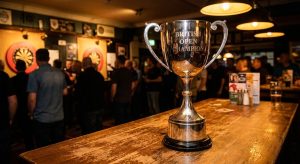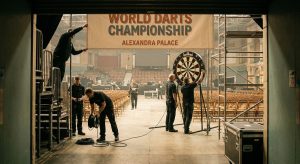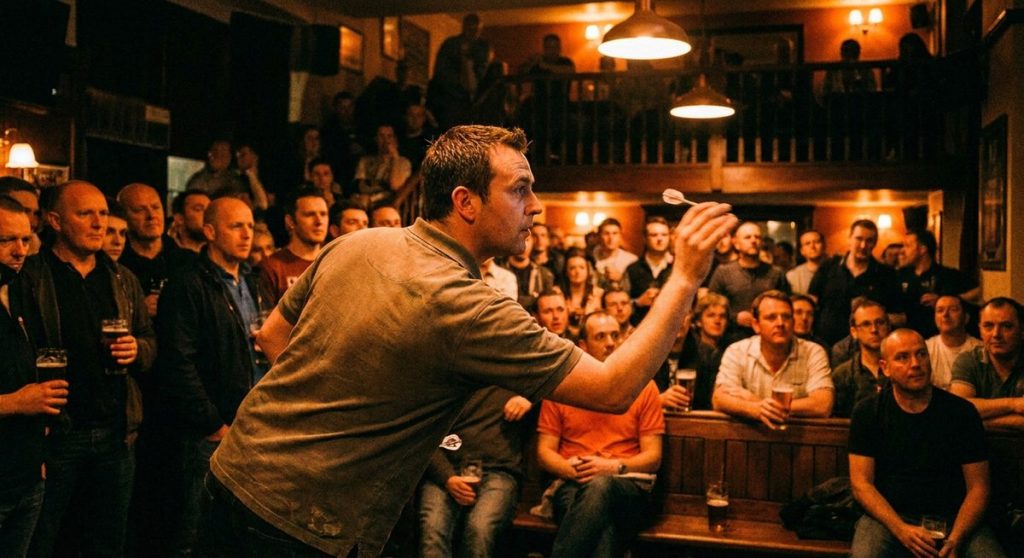
The BDO World Darts Championship ran for 43 years, from February 1978 to January 2020. It was the original world title in the sport, run by the British Darts Organisation under Olly Croft, and for most of its life it meant one thing: Frimley Green in January. The Embassy cigarettes smell, the packed rows at Lakeside, and darts on BBC. Then it fell apart. This is what happened.
A Tournament Born in 1978
The BDO staged the first World Professional Darts Championship in February 1978 at the Heart of the Midlands Nightclub in Nottingham. Leighton Rees beat John Lowe in the final to take the title. Embassy Cigarettes put up the prize fund: a total of £10,500, with the champion getting £3,000. Not a fortune even by 1978 standards, but it was a start.
Olly Croft, the BDO founder, had built the organisation from scratch after establishing it in 1973. His vision was a structured, properly governed sport rather than a collection of pub leagues and regional competitions. The World Championship was the centrepiece of that vision.
From Nottingham the tournament moved to Jollees Cabaret Club in Stoke-on-Trent for 1979, where it stayed until 1985. Good crowds, decent atmosphere, but nothing like what came next.
In 1986 the championship moved to Lakeside Country Club in Frimley Green, Surrey. It stayed there for 34 consecutive years, through to 2019. In 2020 it moved once, for the final time, to the Indigo at the O2 in London. That was the end.
Embassy held the title sponsorship from 1978 until 2003: 26 years in which the tournament was officially called the Embassy World Professional Darts Championship. When Imperial Tobacco finally pulled out, the BDO rebranded to the Lakeside World Professional Darts Championship, leaning into the venue’s reputation rather than finding new commercial backing. A sign of things to come.
The Lakeside Years (1986–2020)
Thirty-four years at the same venue is unusual for any sporting event. What made it work was the combination of a genuinely distinctive space, a loyal crowd, and an owner who treated the championship as his life’s work.
The Venue and Its Atmosphere
Lakeside Country Club held roughly 1,170 people for the darts. Small by any modern sporting standard. The oche was close to the front rows. You could see the players’ faces clearly. You could hear what they said to the MC. You could feel the nerves.
There’s nowhere to hide in a room that size. When a match turned, the whole crowd turned with it. When someone threw a 180 the noise was immediate and physical, walls, ceiling, the lot. The PDC moved to arenas that hold 5,000, 10,000, 17,000 people. Different experience entirely. Not better. Different.
Lakeside in January had a specific atmosphere that regular attendees recognised instantly. Slightly damp coats drying out after the queue in the cold outside. The particular configuration of the stage lighting. The way the MC’s voice carried in that room. The 2007 quarter-finals felt exactly as the old footage from the early 1990s suggests. That kind of consistency either comes from good management or from a venue with genuine character. Lakeside had both.
Bob Potter and the Man Behind It All
Bob Potter opened Lakeside Country Club in 1971. Before that, he’d been booking bands across the South East: the Beatles, the Rolling Stones, acts of that scale. When he built Lakeside he brought that entertainment instinct with him. Tommy Cooper, Bob Monkhouse, Morecambe and Wise all played there. Diana Ross. Tom Jones. It was genuinely one of the finest entertainment venues in southern England.
Then in November 1978, a fire almost completely destroyed it. Potter rebuilt it and reopened in October 1979. Bigger and better than before, as the saying goes, and in this case it was true.
By 1986 Lakeside was the right venue for the right event. Potter embraced darts wholeheartedly, building the championship into the fabric of what the club was known for. He received his OBE in 1993 and continued running the venue until late in his life. He died in April 2023, aged 94.
The BDO World Championship at Lakeside was his project as much as Croft’s. Without Potter, there’s no Lakeside era. The tournament might still have happened somewhere, but it wouldn’t have had that particular identity.
How Prize Money Told the Story
Prize money is a crude measure but it doesn’t lie about the direction of travel.
In 1978 the total fund was £10,500, champion’s share £3,000. By the mid-1990s, after Embassy had grown the event through its peak television years, the men’s champion was taking home £36,000. The tournament’s total prize pool passed £300,000 by 2009, with the men’s winner receiving £100,000.
Then the decline. Slowly at first, the PDC was drawing the bigger players and the bigger broadcasters, then faster. By the late 2010s the figures had been quietly trimmed. Nobody announced it loudly. The pool shrank each year.
The 2020 tournament was where it became impossible to ignore. Just days before the event was due to start, players were informed that the prize fund had been cut from its advertised level to approximately £150,000 total. The men’s champion Wayne Warren won £23,000. Glen Durrant had taken home £100,000 for winning in 2019.
The players had already committed. Flights, hotels, preparation time. Finding out the prize money had been halved at the last minute wasn’t just financially damaging. It demonstrated how far the organisation had fallen. This wasn’t a shortfall being managed carefully. It was a crisis being hidden until it couldn’t be any longer.
The Split That Changed Everything: BDO vs PDC 1993
In January 1993, the 16th BDO World Championship was held at Lakeside. It was the last one that looked like the full sport.
By that point darts had lost much of its BBC television presence. The sport had boomed in the early 1980s: multiple tournaments broadcast, strong viewing figures, household-name players. By the end of the decade, coverage had contracted sharply. The BDO, for all its organisational competence in the amateur game, had not solved the television problem. The top professionals were frustrated.
On 24 January 1993, a couple of weeks after that year’s championship ended, the BDO suspended the 16 professional players who had signed the World Darts Council’s statement of 7 January, refusing to play in any world championship the WDC did not sanction. The players included Eric Bristow, John Lowe, and Phil Taylor. A worldwide ban followed: anyone who associated with the rebels faced exclusion from BDO events.
The WDC held its first World Championship at the Circus Tavern in Purfleet in late 1993. Four years of legal action followed before the 1997 Tomlin Order formally confirmed both bodies’ existence and established that players could choose which one to play for.
The long-term damage to the BDO field was irreversible. Phil Taylor went to the PDC and won 14 World Championships there. The PDC built prize money that made the BDO look amateur by comparison. Players who might have stayed in the BDO looked at the numbers and left. By the 2010s, the BDO World Championship field, once genuinely the best in the world, had become a tournament of players who hadn’t made the PDC cut or had chosen deliberately to stay outside it.
That’s not a criticism of every BDO champion from 1994 onwards. Several were genuinely excellent players. But the competitive depth was never the same.
On Television: From BBC Primetime to the Margins
The BBC broadcast the first championship in 1978 and stayed with the BDO for nearly 40 years. The 1983 final, Deller versus Bristow, was watched by more than eight million. Between 2001 and 2015 the Lakeside final still drew between 1.8 and 3.7 million viewers. These were not niche viewing figures.
Darts on BBC in January was part of the sporting calendar in the same way as Wimbledon or the Grand National. The Lakeside coverage had a specific rhythm: afternoon sessions with the women’s matches and earlier rounds, evening sessions with the later stages, build to the finals weekend. Sid Waddell on commentary. Tony Green on the oche as MC. Familiar and reliable.
The BBC began reducing its commitment from 2012, sharing live evening session rights with ESPN. After the 2016 championship they opted out entirely. Channel 4 took over free-to-air rights from 2017, with BT Sport holding additional coverage. Then Channel 4 stepped back too. The 2019 and 2020 tournaments were on Quest, a minor free-to-air channel most viewers could find if they looked, but couldn’t name off the top of their heads.
By 2019 the audiences had fallen to levels that would have been unimaginable in 1995. Darts hadn’t gone away: the 2024 PDC world final at Alexandra Palace drew a record average audience of 3.1 million on Sky Sports. But BDO darts at Lakeside had become a niche product watched by a shrinking community of loyalists. The BBC switch to PDC coverage confirmed where the audience had gone.
Records, Upsets and Unforgettable Moments
Paul Lim’s Perfect Leg
On 9 January 1990, Paul Lim threw the first nine-dart finish in World Championship history. He was playing Jack McKenna in the second round at Lakeside. T20, T20, T20, T20, T20, T20, T20, T19, double 12: nine darts, 501 checked out, the crowd going completely to pieces.
Embassy had put up a £52,000 bonus for anyone achieving a nine-darter at the championship. Lim collected it. For context, Phil Taylor won the men’s title that year and received £24,000. Lim won more for a single leg of darts than the champion took home for winning the whole tournament.
Lim won that match 3–2 and went out to Cliff Lazarenko in the quarter-finals. He never reached a BDO world final. But the nine-darter at Lakeside is what he’s remembered for, and it’s the right thing to remember him for. No one had done it at a World Championship before. No one has done it in the BDO/WDF World Championship since.
Bristow, Gulliver and the Champions Who Defined Eras
Eric Bristow won five BDO World Championships: 1980, 1981, 1984, 1985, and 1986. He appeared in 10 finals, more than anyone else in the tournament’s history. From 1984 to 1986 he won three in a row. At his peak, Bristow was categorically the best player in the world, and he knew it, and he was not shy about letting you know he knew it.
His five titles makes him the men’s record holder. The 1983 final remains the biggest upset in the championship’s history. Keith Deller came in as a qualifier, some reports placed his starting odds at 500/1, beat the world’s top three ranked players on his way to the final, and then beat Bristow himself 6–5 in sets, finishing on a 138 checkout. Bristow needed double 16 to stay in the match with his last dart and missed it. Ten million people watched.
On the women’s side, Trina Gulliver from Southam in Warwickshire won ten BDO Women’s World Championships between 2001 and 2016. Ten. She won the first seven in a row, from 2001 to 2007, before losing the 2008 final to Anastasia Dobromyslova. She came back and won again in 2010, 2011, and 2016. Her dominance of the women’s game at Lakeside has no equivalent on the men’s side. Bristow’s five stayed the men’s record at the BDO championship; only Phil Taylor, with fourteen PDC world titles, won more at a single championship.
The End in 2020: and What Came After
The 2020 BDO World Championship was held at the Indigo at the O2, not Lakeside. The BDO had been struggling financially for years and had lost the Lakeside contract. Moving to London was presented as a positive step, larger capacity, better facilities, more accessible. It was, in practice, an admission that the relationship with Frimley Green was over.
Wayne Warren won the men’s title. Glen Durrant took it in 2019. Good champions, both. The 2020 final deserved a better backdrop than an organisation visibly falling apart around it.
In July 2020, the BDO’s commercial division entered insolvency. In September 2020, the organisation collapsed entirely. Forty-seven years after Olly Croft had founded it, the British Darts Organisation was gone.
The World Darts Federation, the international governing body of which the BDO had been the British member, stepped in. The WDF World Championship launched in 2022, held back at Lakeside Country Club in Frimley Green. Bob Potter was still alive. The darts came home, at least in a formal sense.
Whether the WDF championship will build the audience the BDO had at its peak is a different question. What’s not in doubt is that the 34 years at Lakeside from 1986 to 2019 constituted something specific and unrepeatable: a world championship held in a room small enough that you could see what the players’ eyes were doing. Most sports venues got bigger over those decades. Lakeside stayed the same size. That was the point.