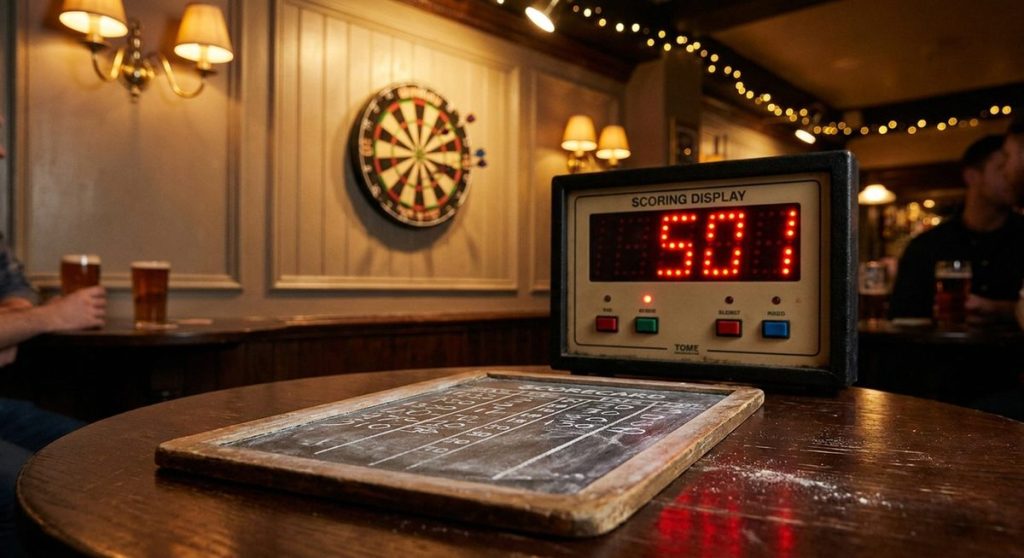
Start at 501. Throw darts. Count down to zero, but the final dart must land in a double or the bullseye. That’s 501. Everything else is detail, and the detail matters when you’re standing on the oche with 32 left and your hand isn’t cooperating.
The Object of the Game
Both players (or teams) begin with a score of 501. Every dart thrown scores points, and those points are subtracted from the running total. The first player to reach exactly zero, finishing on a double, wins the leg. Not whoever gets closest. Not whoever runs out of darts first. The player who hits the right double at the right moment.
That last requirement changes everything about how the game is played. A player sitting on 40 isn’t four darts from winning. They need double top, and if they miss it, they might not get another clean look for several turns.
How Scoring Works
The standard dartboard runs from 1 to 20, arranged in a fixed sequence around the face. Each number has three scoring zones: the single (the large segment), the double (the narrow outer ring), and the treble (the narrow inner ring). Doubles are worth twice the segment value; trebles are worth three times.
The highest single score from one dart is the treble 20, worth 60 points. Three treble 20s in a single visit, the maximum 180, is the benchmark of professional scoring. You’ll hear the crowd react before the commentator finishes the sentence.
The centre of the dartboard has two zones. The outer bull scores 25 points. The inner bull, the small red circle at the very centre, scores 50 and counts as a double. It’s double 25, in effect. That distinction matters when calculating checkouts. A player on 50 can finish on the inner bull. A player on 25 cannot. 25 is an odd number, and there’s no double worth 12.5.
Each visit to the oche consists of three darts. Players throw alternately, one full set of three darts per visit. Scores are recorded after each visit.
The Double Out Rule
This is what separates 501 from a simple countdown exercise. The final dart of any winning visit must land in a double segment or the inner bull. Miss the double, hit the single, hit the wire, miss the board, and the score stands where it was. Your visit ends. Your opponent throws.
Going bust is the other thing to understand. If your three darts reduce your score below zero, to exactly one, or to zero without finishing on a double, the visit is a bust. Your score reverts to what it was at the start of that turn, all three darts count for nothing, and play passes to your opponent. So a player on 32 who throws a single 16 is now on 16. If they then hit a single 15 with their second dart, they’re bust: 16 minus 15 is one, and you cannot finish from one. Score goes back to 32. Three darts wasted.
The double out rule is what makes 501 a test of nerve as much as accuracy. Scoring is hard enough. Finishing, consistently, under pressure, is where matches are actually decided. Anyone who watched the BDO World Darts Championship at Lakeside knows that a player can outscore their opponent for most of a leg and still lose it on the doubles.
Common Finishes
Checkout combinations, the sequences that take you from a given score to zero in one visit, are something serious players memorise. The table below covers the most commonly cited finishes, from the maximum three-dart checkout downwards.
| Score | Dart 1 | Dart 2 | Dart 3 |
|---|---|---|---|
| 170 | T20 | T20 | Bull |
| 167 | T20 | T19 | Bull |
| 164 | T20 | T18 | Bull |
| 161 | T17 | T18 | Bull |
| 160 | T20 | T20 | D20 |
| 121 | T20 | T11 | D14 |
| 100 | T20 | D20 | – |
| 81 | T19 | D12 | – |
| 40 | D20 | – | – |
| 32 | D16 | – | – |
170 is the highest possible checkout, treble 20, treble 20, bullseye, and it’s been hit at Lakeside more than once. 160 is the highest finish that doesn’t require the bull, which some players prefer under pressure. The two-dart finishes (100 downwards) come up repeatedly across a match; knowing them automatically removes one variable from an already pressured situation.
Scores of 169, 168, 166, 165, 163, 162, and 159 cannot be finished in three darts. These are the “impossible” checkouts. If you’re sat on 169, you need to score something first.
Legs, Sets, and Matches
A single game of 501 is called a leg. Matches are structured as a series of legs, and in tournament play, legs are grouped into sets.
In most professional formats, a set is won by the first player to take three legs. A match is decided by sets: best of five in early rounds, building to best of 13 sets in a championship final, first to seven sets taking the title. That’s the format the BDO used at Lakeside: the men’s final was best of 13 sets, each set first to three legs.
The opening leg of a match is decided by a throw for the bull. Closest dart to the bullseye throws first. After that, whoever won the previous leg throws first in the next. Throwing first matters: you get the first chance to post a score your opponent has to chase.
For a full breakdown of how these darts rules applied across different rounds and competitions, the BDO format page covers the variations in detail.