Dartboard Setup: Official Height and Distance Rules
Get the measurements wrong and nothing else matters. The board can be perfect, your darts can be tungsten, but if the bullseye is two inches too high or the oche is short, you’re not playing to the official standard. These are the numbers used at every BDO and WDF sanctioned event, including Lakeside for its entire 34-year run. They haven’t changed since 1977.
The Official Measurements
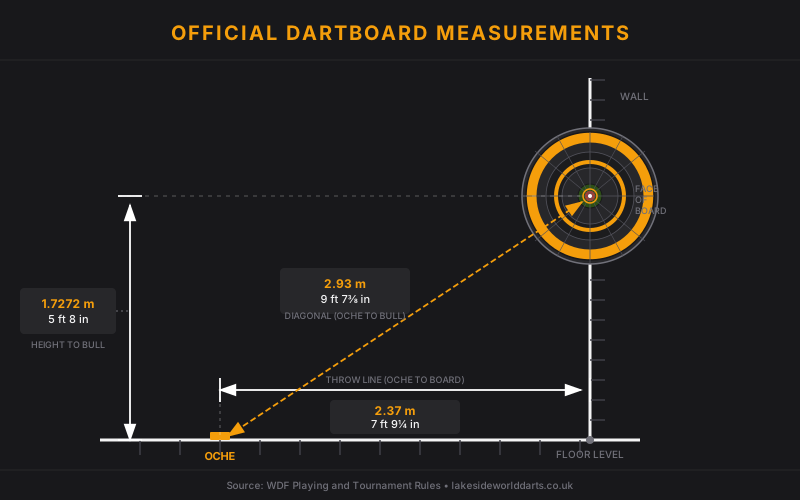
Three numbers define a legal dartboard setup.
Bullseye height: 5 ft 8 in from the floor to the centre of the bull. In metric, that’s 1.7272 metres exactly: not the rounded 1.73 m you’ll see on some packaging.
Throwing distance (the oche): 7 ft 9¼ in from the face of the dartboard to the front edge of the throwing line. The official metric figure is 2.37 m, though the precise conversion of 7 ft 9¼ in is 2.3688 m. The WDF adopted 2.37 m in 1977; the difference is roughly the thickness of a sheet of paper.
Diagonal check: 9 ft 7⅜ in (2.93 m) from the front of the oche to the centre of the bullseye, measured diagonally. This cross-check confirms both measurements at once. More on that below.
These measurements apply to steel-tip darts. Soft-tip electronic boards use a longer oche, 8 ft (2.4384 m), and a different diagonal. Everything here relates to steel-tip, which is the BDO, WDF, and PDC standard.
Height: 5 ft 8 in to the Bull
Measure from the floor to the exact centre of the bullseye. Not the top of the board: the bull itself. In metric: 1.7272 m. The number needs to be right because your throwing angle, release point, and sight line all calibrate to that height without you realising it. Hang the board two inches too low and you’ll spend months compensating without knowing why.
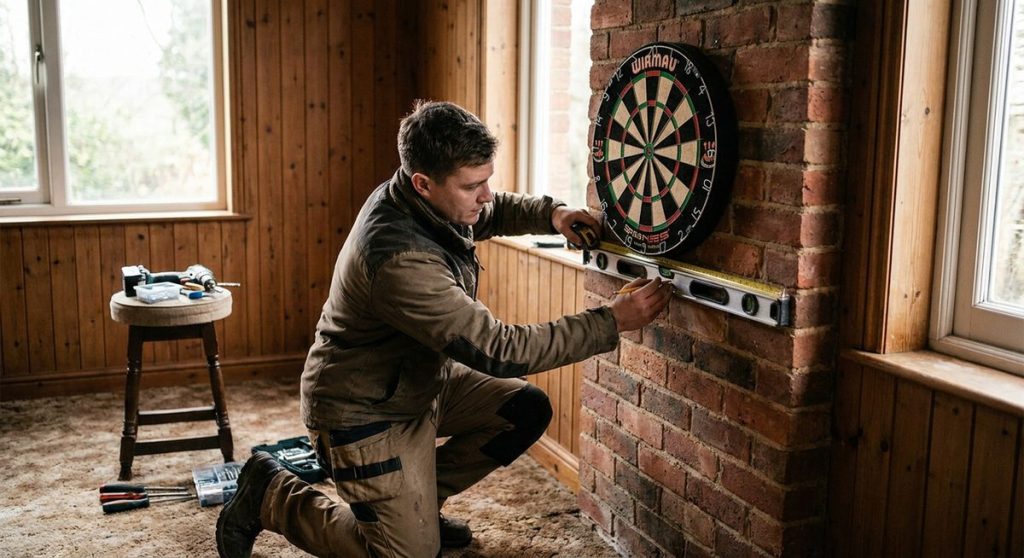
If the face of the board projects out from the wall, because of a cabinet or surround, the oche must move back by the same amount. Throwing distance is measured from the board face, not the wall. Use a spirit level before fixing. A tilted board skews every wire on the scoring ring.
Throwing Distance: 7 ft 9¼ in
The oche sits 7 ft 9¼ in from the face of the board. Not 7 ft 9 in. The quarter inch is part of the official measurement.
Before the WDF standardised this at the 1977 World Cup meeting, oche distances varied across the country: 7 ft, 7 ft 6 in, 8 ft, even 9 ft in some regions. The 1977 decision fixed that. Since then, 7 ft 9¼ in has been the global standard for steel-tip darts.
The measurement is taken horizontally from the board face to the front edge of the oche. The oche should be at least 18 inches wide and clearly marked. Check that it sits directly below the bullseye. Any lateral offset introduces error. For the complete darts rules context, that’s covered separately.
The Diagonal Check
Once height and oche distance are set, the diagonal from the front edge of the oche to the bull centre should be 9 ft 7⅜ in (2.93 m). It’s the hypotenuse of a right-angled triangle with legs of 5 ft 8 in and 7 ft 9¼ in.
One tape measure stretched diagonally from oche floor to bull centre tells you whether both measurements are correct simultaneously. If the diagonal is right, height and distance are right. If it’s off, one or both needs adjusting. Faster than re-measuring each dimension separately, and it catches errors that floor-level measurements miss when the surface isn’t perfectly level. Use a rigid tape, not a cloth one. Get within a centimetre and you’re set.
Setting Up at Home
Start with a solid wall surface. Plasterboard alone won’t hold under regular use. Find a stud or use wall anchors rated for the weight. A regulation board runs around 4–5 kg; add a cabinet and you’re adding more.
The install sequence:
- Mark the wall at 1.7272 m (5 ft 8 in) from the floor. That’s where the mounting bracket goes, not the top of the board.
- Mount the board and check it’s level.
- Mark the oche at 7 ft 9¼ in (2.37 m) from the board face, measured horizontally.
- Run the diagonal check: 9 ft 7⅜ in from oche front to bull centre.
- Fix the oche line permanently: wood strip, raised mat edge, or adhesive oche tape.
A dartboard surround catches most stray darts before they hit the wall. A rubber mat behind the oche gives you a consistent surface. Neither is compulsory at home, but both matter if you’re practising seriously. Playing at the wrong distance builds habits calibrated to the wrong setup. The full 501 darts rules are worth knowing alongside these measurements if you’re starting from scratch.