Darts Rules: The Official BDO Format Explained
Darts is simpler than it looks and more precise than most people expect. You start at 501, you throw to zero, and you must finish on a double or the bullseye. That’s the game. Everything else, the format, the measurements, the tournament structure, builds out from that single rule.
What follows covers the official BDO/WDF rules as they applied at the Lakeside World Professional Darts Championship from 1986 until 2019. Some of these specifics matter if you’re playing competitively. All of them matter if you want to watch the sport properly and understand what’s happening on stage.
The Basics: How a Leg of Darts Works
Each player starts a leg with exactly 501 points. You throw three darts per turn, subtract your score, and work down to zero. Simple arithmetic, until it isn’t.
The catch is the finish. You cannot win a leg by simply reaching zero. Your final dart must land on a double segment or the bullseye (which counts as a double). If you hit zero on a single or treble, the turn is void and your score reverts to what it was at the start of that visit. That’s the bust rule. Go past zero, or reach zero on the wrong segment, and nothing counts.
This is why doubles dominate professional darts. A player at 32 needs double 16. At 40, double 20. Miss the double and you’re still standing there, score unchanged, watching your opponent step up. The endgame pressure is entirely about hitting those narrow outer segments under a room of 1,170 people staring at you.
Players also need a minimum score of 2 remaining to finish, double 1 being the lowest possible checkout. A player left on 1 is “on a bag of nuts” in old darts parlance: stuck, no valid out, waiting to bust their way back to a workable number.
The Official BDO World Championship Format
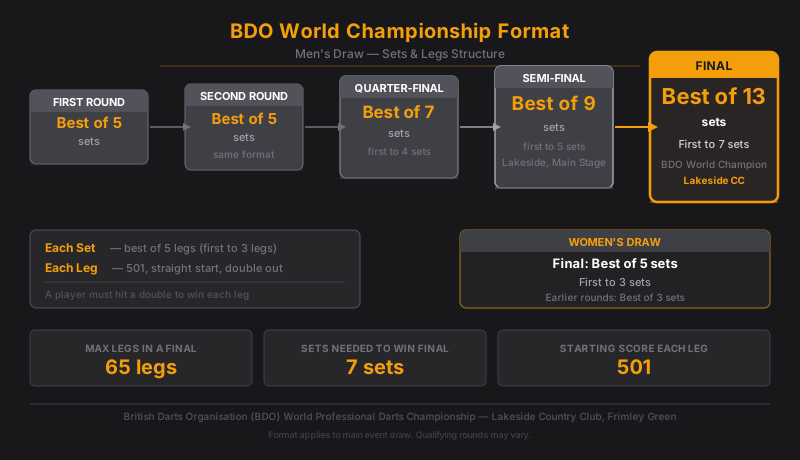
The Lakeside championship used a sets-and-legs format throughout its history. A set is won by the first player to take three legs. The match is decided by sets.
How many sets depended on the round:
- First round: Best-of-5 sets (men), Best-of-3 sets (women)
- Second round through to the semi-finals: Best-of-7 sets (men), Best-of-5 sets (women)
- Final: Best-of-13 sets (men), Best-of-9 sets (women)
The men’s final structure meant a potential maximum of 13 sets, each up to five legs: 65 legs at the extreme. In practice, few finals went deep. Most were settled somewhere between six and ten sets. But the format gave both players the opportunity to recover from a slow start, which is why you occasionally saw players come back from 4-1 down in sets and still win.
The women’s draw ran alongside the men’s throughout the Lakeside era, sharing the same stage and the same crowd. Best-of-3 sets in the early rounds was tight. One bad set and you were done. Trina Gulliver won eight world titles under that format between 2001 and 2010. Eight. The compressed structure made every leg critical from the first throw.
Throw order within a match was decided by a bull-off: each player threw one dart at the bullseye; nearest to the bull threw first in the opening leg. After that, the loser of each leg threw first in the next: a small but meaningful structural advantage when you’re chasing a match. Throwing first in a leg means you can put pressure on before your opponent reaches the board. At BDO level, that matters.
Dartboard Setup: Measurements You Need to Know
These are the official BDO/WDF measurements. They’re standardised and non-negotiable at any sanctioned event.
Bullseye height: 5 ft 8 in: exactly 1.7272 metres from the floor to the centre of the bullseye.
Throwing distance (the oche): 7 ft 9¼ in: 2.369 metres, measured horizontally from the face of the board (not the wall) to the front edge of the throwing line. That ¼ inch matters. It’s not 7 ft 9 in; it’s 7 ft 9 and a quarter.
Diagonal measurement: The diagonal from the front of the oche to the bullseye is 9 ft 7⅜ in (2.931 metres). Used as a cross-check when setting up boards.
The board itself is 451mm in diameter. Scoring segments run from 1 to 20 around the face, arranged in a specific order, not sequential, designed to penalise inaccuracy. The 20 sits at the top. Either side of it: 5 (left) and 1 (right). Miss a 20 slightly and you’re scoring 5 or 1. That layout is deliberate.
Any board used in BDO/WDF competition had to meet these dimensions exactly. The oche at Lakeside was set to the millimetre. No exceptions.
Scoring: How to Read the Board
The dartboard has four distinct scoring zones:
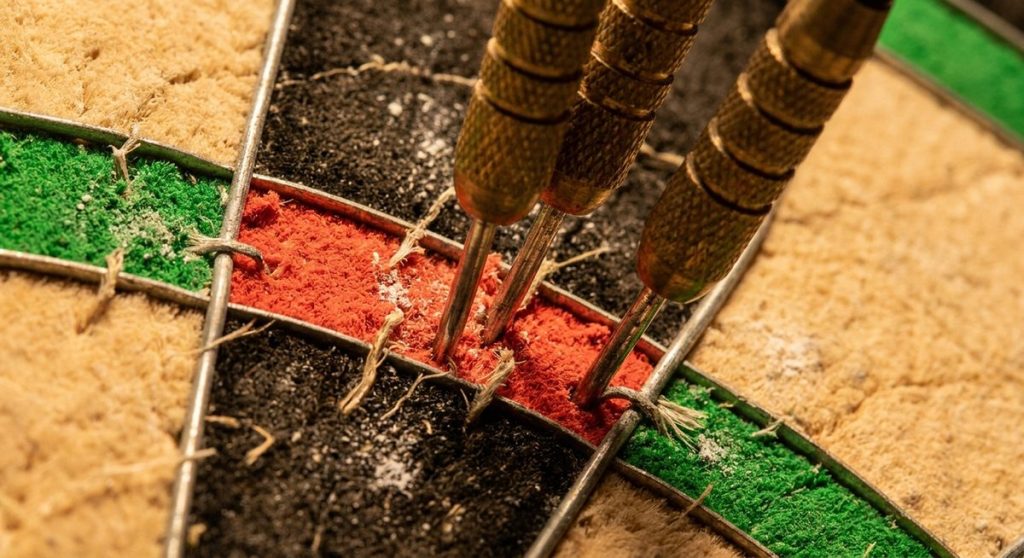
Single: The large area between the outer bull ring and the outer wire. A dart in the single 20 scores 20 points.
Double: The narrow outer ring. A dart here scores twice the segment value. Double 20 scores 40. Double 1 scores 2. There are 20 doubles on the board.
Treble (triple): The narrow inner ring, roughly halfway between the outer wire and the bull. A dart here scores three times the segment value. Treble 20, the famous “top treble”, scores 60 points. Three treble 20s in a single visit scores 180. That’s a maximum. Twenty trebles on the board.
Bull: The centre of the board has two parts. The outer bull (single bull) scores 25. The inner bull (double bull, or bullseye) scores 50. The bullseye counts as a double for finishing purposes.
The highest single-visit score is 180, three treble 20s. It’s called a “maximum” or “ton-80.” At Lakeside, a maximum from the crowd would get a bigger reaction than almost anything except a winning dart. Phil Taylor hit one at Lakeside in 1993. Didn’t win him the title that year, but the crowd remembered it.
Starting and Finishing: The Rules Around Checkout
You can only finish a leg on a double or the bullseye. That means certain scores require specific combinations. A few worth knowing:
170the highest possible checkout. Treble 20, treble 20, bullseye. Three darts. This is called a “170 finish” and it’s relatively rare at the top level. Not because professionals can’t hit it, but because they rarely need to from 170.
167Treble 20, treble 19, bullseye.
164Treble 20, treble 18, bullseye.
Scores of 169, 168, 166, 165, 163, 162, and 159 are not finishable in three darts. These are called “bust numbers” awkward scores you don’t want to land on when a leg is close.
The standard finishing routes for common scores:
- 121: Treble 20, single 11, double 25 (bull)
- 100: Treble 20, double 20, two darts if you’re accurate
- 40: Double 20, one dart
- 32: Double 16
- 2: Double 1
Professional players know every checkout from 170 down. They’re not calculating at the oche, it’s automatic. When a commentator says someone is “on a finish,” that means their remaining score can be taken out in three darts or fewer.
Three-dart average is the standard performance metric in darts. It measures the average score per three-dart visit across a match or a leg. A BDO World Championship finalist in the 2000s was typically averaging between 88 and 95. Anything over 100 in a televised match was exceptional. The average captures both scoring power and finishing efficiency: a player who scores well but misses doubles repeatedly will see their average drop fast once the match goes deep into sets.
Common Mistakes and Rule Clarifications
A few situations that cause confusion, even at club level:
Bounce-outs: If a dart bounces off the wire and doesn’t stick in the board, it scores zero. No rethrow. The dart is dead. At Lakeside, bounce-outs happened occasionally and they hurt: particularly in the final few darts of a close leg.
Dart falls from board: If a dart falls out of the board before the score is recorded by the marker, it scores zero. Once the score is called and marked, it stands, even if the dart then falls. This is why professionals wait for the marker to confirm before pulling darts.
Scoring a maximum (180): All three darts must remain in the treble 20 at the time of scoring. A dart that deflects and moves another dart out of a treble changes the score accordingly. The score is taken from where the darts are when the marker records it, not from where they landed.
Foot fault: Any part of the player’s throwing foot that extends over the front of the oche during the throw is a foot fault. The dart scores zero. In practice, professionals rarely foot-fault, it’s more of a club-level issue, but BDO officials were strict about it at Lakeside.
Finishing on an unexpected double: A player needs double 16 but hits double 8 instead. Double 8 scores 16. That reduces their score to exactly zero on a double. The leg is won, not lost. The rule is about the type of segment, not a pre-declared target. Any double that reduces your score to exactly zero ends the leg in your favour.
One more that trips people up: if a player has three darts remaining and needs a score that can only be finished in two darts, they don’t have to use all three. The third dart is simply not thrown. The leg ends as soon as the checkout is complete, regardless of how many darts remain in hand.