There’s a version of the BDO–PDC split that gets told as a clean story. Unhappy players, bold breakaway, two rival world championships, sorted. It wasn’t clean. It was messy and bitter and it left marks on the sport that you can still trace today if you know where to look. Anyone who followed darts through the late eighties will remember the atmosphere in early 1993, not excitement, not celebration. Unease. Something was ending.
Why the Players Left
The British Darts Organisation had run professional darts since 1973. By the late eighties it was visibly struggling. Television coverage was shrinking. The BBC’s relationship with the sport had cooled. Sponsorship money that had been reliable through the boom years, when darts pulled in peak audiences on ITV and the BBC, was no longer flowing the same way. Players were travelling to tournaments across Britain and Europe for prize funds that hadn’t moved in years. Meanwhile, snooker players, golfers, tennis players, were earning multiples more for comparable ability and effort.
The top darts players weren’t short of talent. What they were short of was leverage. The BDO controlled the sanctions, the rankings, and crucially, the world championship, the BDO World Darts Championship at Lakeside, which was the only event in the sport that really mattered to the public. Walk away from the BDO and you walked away from all of it. Or so the BDO believed.
The players disagreed. They’d been having conversations, serious ones, not just pub grumbling, about forming their own body since the early nineties. The World Darts Council was established in 1992. On 7th January 1993, sixteen of them signed a statement making the break official: they would only participate in the 1994 World Championship if it came under WDC auspices. They recognised only the WDC as having authority to sanction their participation in tournaments worldwide.
The BDO didn’t see it coming. Or if they did, they didn’t believe it.
The Sixteen Rebels
These were the sixteen men who signed on 7th January 1993. Not fringe players. Not players with nothing to lose.
Phil Taylor had won the BDO world title in 1990, a 125/1 outsider who beat Eric Bristow 6–1 in the final, and again in 1992, defeating Mike Gregory 6–5 in one of the most dramatic finals Lakeside had ever seen. He was 32 years old and at the height of his powers. Dennis Priestley had won the world title too, in 1991. John Lowe was a three-time world champion, one of the most decorated players in the history of the sport. Eric Bristow, five world titles, the face of the game through the eighties, signed as well. Jocky Wilson, twice world champion, was on the list. Keith Deller, who’d beaten Bristow as a 500/1 shot in 1983, was there.
The full sixteen: Phil Taylor, Dennis Priestley, Rod Harrington, John Lowe, Alan Warriner, Eric Bristow, Jocky Wilson, Bob Anderson, Peter Evison, Jamie Harvey, Ritchie Gardner, Cliff Lazarenko, Kevin Spiolek, Keith Deller, Mike Gregory, and Chris Johns.
Between them, they held the vast majority of world titles that had ever been awarded. These weren’t journeymen. They were the sport. And they’d just told the BDO they were done.
What the BDO Did Next
The BDO’s response was swift and, from their perspective, logical. On 25th April 1993 they voted to ban any player or official “associated with the activities of the World Darts Council” from all BDO-sanctioned events. In October 1993 the World Darts Federation ratified the ban worldwide, though the USA and Canada refused to enforce it, citing issues with their own constitutional frameworks.
From the BDO’s point of view, this was about protecting the integrity of the organisation. You can’t run a professional sport if your top players can unilaterally decide they answer to a different body. The ban was meant to force a choice: come back to the BDO, or be shut out of every major tournament in the world.
The problem was that the WDC didn’t collapse. It found a television deal, Channel 4, then Sky Sports, and staged its own world championship, first at the Circus Tavern in Purfleet, Essex. Not Lakeside. Not the Frimley Green crowd. But television coverage, and prize money that started climbing immediately. The BDO’s calculation, that the rebels would blink, was wrong.
Both sides then spent four years digging in. The BDO rebuilt its player roster from the players who hadn’t signed, good players, some excellent ones, and carried on at Lakeside. The WDC ran its own circuit. There were effectively two professional darts worlds operating in parallel, with no crossover and considerable hostility between them.
The 1997 Court Case
The legal confrontation came eventually. By mid-1997 the WDC players were taking the BDO and the WDF to the High Court, arguing that the worldwide ban constituted an unlawful restraint of trade. That it was preventing professional sportsmen from earning a living in their chosen profession.
The case didn’t reach a full hearing. On 30th June 1997, both sides reached a compromise: a Tomlin order, a consent settlement brokered with the judge’s agreement. The judge had indicated clearly that the right of the WDC players to carry out their profession had been unreasonably restricted. That was enough.
The BDO lifted the ban completely. The WDC dropped its damages claim for loss of earnings. And the WDC agreed to remove the word “world” from its name. They became the Professional Darts Corporation, the PDC, acknowledging that the BDO and the WDF retained the claim to be the international governing body. Players from both organisations could now freely participate in open events.
On paper it looked like a compromise. In practice, the damage was permanent. The top players had been in the PDC system for four years. Taylor had won the PDC world title in 1995 and 1996. The prize money was already diverging. Nobody who mattered was coming back.
What the Split Actually Meant
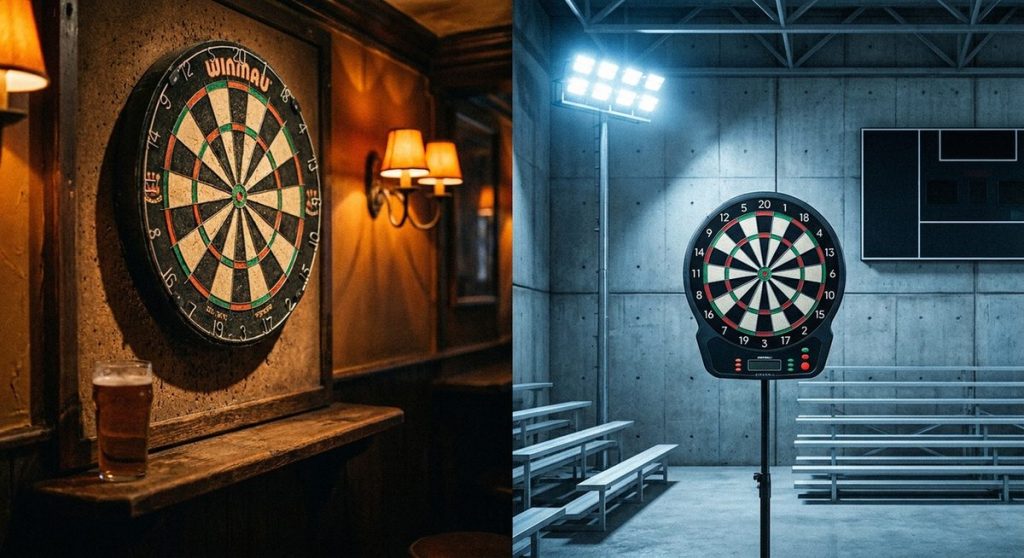
Two world championships. Two oche cultures. That’s the legacy.
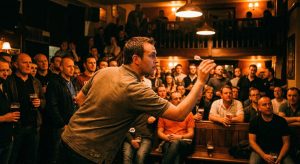
The greatest BDO players of the Lakeside erathe ones who came through after 1993, built careers under the BDO banner, won at Frimley Green. Did so in a world where the sport’s commercial oxygen was flowing in a different direction. Lakeside had atmosphere, tradition, a crowd that understood what it was watching. The Circus Tavern had Sky Sports and growing prize funds. By the mid-2000s the gap in prize money between the two world championships had become embarrassing for the BDO.
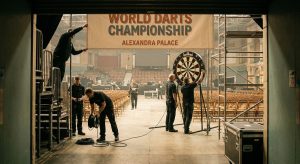
The PDC had Sky Sports and Barry Hearn, who took over as chairman in 2001 and immediately understood that darts had untapped commercial potential that the BDO model had never been able to exploit. Alexandra Palace replaced the Circus Tavern in 2008, around 3,200 a session in the West Hall, fancy dress, proper television production, and the contrast with Lakeside became the whole narrative. Intimate versus spectacular. Tradition versus growth.
I don’t think either side was simply wrong in 1993. The players had legitimate grievances. The BDO had a legitimate interest in protecting its structure. But the BDO lost the argument the moment it assumed the ban would hold. It didn’t hold. And once the players spent four years building something else, there was no route back that made sense for anyone.
Lakeside closed as a world championship venue after 2019. The BDO folded in 2020. The world championship the public follows now is the PDC’s, at Alexandra Palace over Christmas and New Year; the WDF stages its own at Lakeside. The split of 1993 took the best part of thirty years to complete. But it completed.