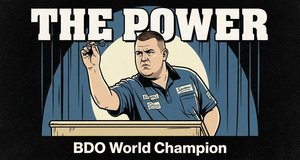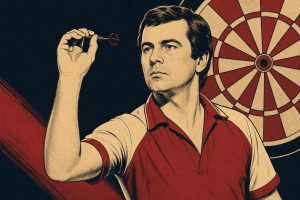
Forty-six minutes. That is how long the 2000 world final lasted, and Ronnie Baxter never won a set of it.
Ted Hankey beat Baxter 6–0 that night, finishing the job with a 170 checkout, the biggest shot the game allows, and the shortest final in the history of the world championship was done before some of the crowd had settled back in with their drinks. Finals are supposed to be attritional. Nobody had told Hankey.
The Count
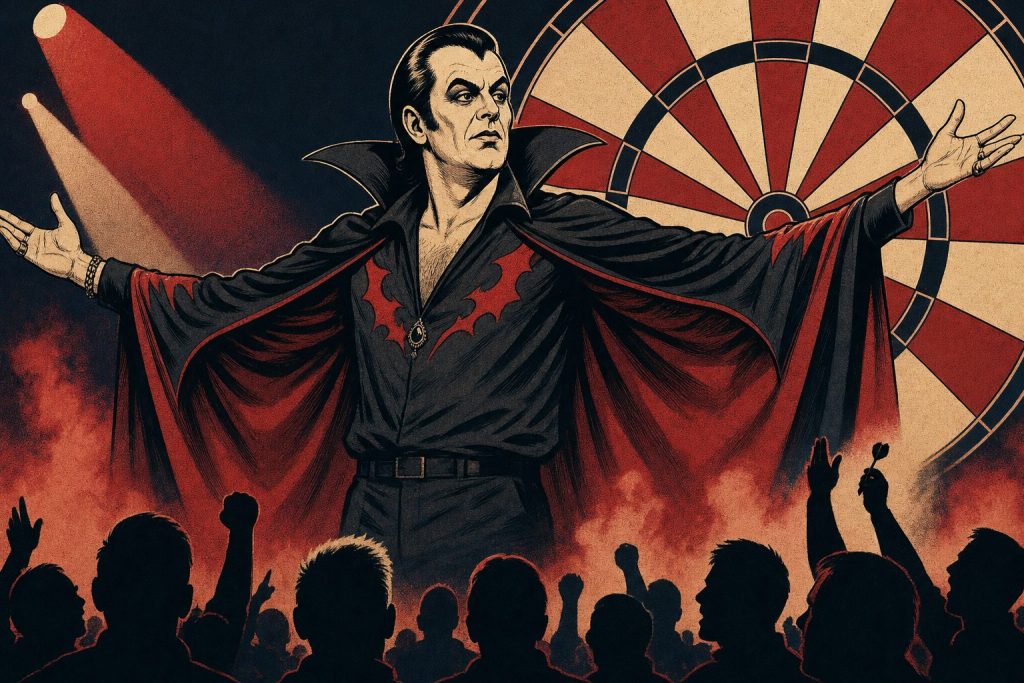
Hankey was born in Stoke-on-Trent on 20 February 1968 and had been throwing darts since 1977, which is to say since he was nine years old. By the time the wider public met him he came with a fully formed persona: The Count, a horror-film villain act played absolutely to the hilt, walking on to DJ Zany’s “Be on Your Way” while the Lakeside crowd gave him exactly the reception a pantomime villain wants.
It would have been a gimmick and nothing more if the darts hadn’t backed it up. The darts backed it up.
January 2000
The numbers from that tournament still read like a misprint. Forty-eight maximums across the week. Twenty-two of them came in the semi-final against Chris Mason alone, a championship record for a single match. Scoring like that does something to an opponent before a final even starts; Baxter walked out to face a man who had spent the week hitting 180 roughly as often as most players hit tops.
And then the final itself: 6–0, sealed with the 170. Forty-six minutes, start to finish. World finals are meant to ebb and swing and fray the nerves of everyone in the room. This one was simply an execution, and it remains the fastest ever staged at the tournament.
The strange thing about a performance like that is what it does to expectation. From that night on, Hankey was measured against his own perfect week. A standard almost nobody could live with, including, for long stretches, Hankey.
The harder years
He nearly did it again immediately. In 2001 he came back to the final, beating Andy Fordham 5–2 in the semi along the way, but John Walton beat him 6–2 on the night and the title changed hands. After that the championship moved on to other stories, the early 2000s at Lakeside belonged mostly to Raymond van Barneveldand Hankey settled into the role of dangerous presence rather than favourite: the name nobody wanted in their quarter, the scorer nobody wanted to stand next to.
The winning didn’t stop entirely. He took the Dutch Open twice, in 1999 and 2003, and stayed a fixture near the top of the BDO game. But a decade is a long time to carry the tag of the man who once won a world final in three-quarters of an hour.
Nine years later
Then came 2009, and a final that was everything 2000 was not. Tony O’Shea stood on the other side of it, and this time nothing was quick and nothing was clean. Hankey led 4–2 at the interval and looked set fair. Then it turned. At 6–5 he had darts to win the world championship and missed them, and a match he had largely controlled was suddenly a coin toss at 6–6.
What happened next is the real argument for Hankey as a player rather than a persona. Having thrown away match darts on the biggest stage the BDO had, he won the deciding set 3–1 and took the title 7–6. The 2000 final proved he could be untouchable. The 2009 one proved he could suffer and still win, which is the rarer and more respectable trick.
Two world titles, nine years apart. Plenty of very good players never win one. Winning a second after a gap that long, after the game has moved on, after the aura has faded, after everyone has decided your moment passed, is close to unheard of.
The last act
There was still theatre left in him. At the Scottish Open in 2011 he hit a nine-darter, the game’s other perfect thing to go with his 170. In 2012 he crossed over to the PDC, and it was there, during a Grand Slam of Darts match against Michael van Gerwen that same year, that he suffered a transient ischaemic attack, a minor stroke, in the middle of the match. Doctors ordered six to eight weeks of rest. He carried on playing into 2013, but the level never quite returned, and in 2014 he lost his tour card, ranked 94th in the world.
Careers tend to get remembered by their sharpest moment, and Hankey’s sharpest moment is not in dispute. A cape, a cackling crowd, forty-eight maximums in a week, and a world final that was over in 46 minutes. Lakeside staged the championship for decades and produced longer nights, closer finishes and bigger names. It never produced another hour quite like that one.