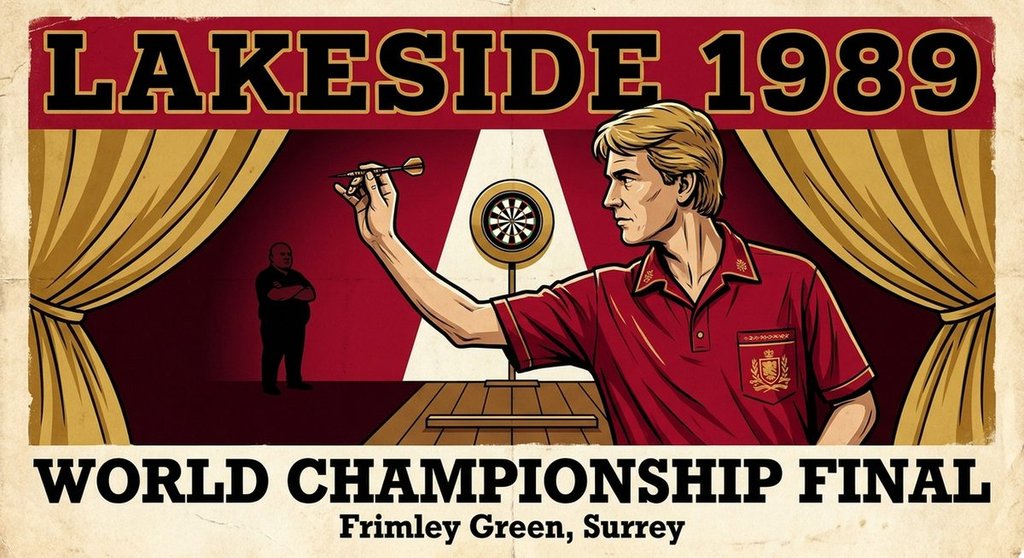
The 1989 Embassy World Professional Darts Championship at the Lakeside Country Club in Frimley Green arrived with one storyline that outweighed every other. Eric Bristow, world champion five times between 1980 and 1986, was chasing a sixth title. Jocky Wilson, champion in 1982, was chasing a second. By the end of the fortnight the Scot had it, 6–4 in sets, and the Lakeside era had one of the finals it is still remembered for.
Bristow in 1989
Bristow’s position at the start of 1989 needs a little context. His fifth title in 1986 had been the first championship staged at Lakeside, and it had looked like the middle of a reign rather than the end of one. Then dartitis set in: the involuntary inability to release the dart, which took hold of his throw from the 1986–87 season and never fully let go. He lost the 1987 final to John Lowe. In 1988 he went out before the final. That he was back in a world final at all in 1989 said a great deal about how much of the old game was still there.
The swagger, the stare and the surgical accuracy on the treble twenty were the reasons the 1,170 people in the room turned up. Whether the release would hold under a Lakeside final was the reason they held their breath.
Wilson’s Second Title
Jocky Wilson had been the first Scot to win the world title, in 1982, beating Lowe 5–3. In the years since he had been a fixture in the latter stages without getting back to the final. In January 1989 he did, and the man in the other seat was the one player of the era who had beaten everybody.
The shape of the final is what people remember. Wilson won the first five sets and stood one set from the title. Bristow, visibly fighting his release, then took four sets in a row to make it 5–4, and with the momentum running entirely his way the room braced for the most famous collapse the championship had ever seen. Wilson steadied, found his doubles again and won the tenth set.
The 6–4 scoreline put Wilson in the record books as a two-time world champion, seven years apart. For a player whose career was as unpredictable as his, and whose relationship with the game was never entirely comfortable, it was the last major peak. He never reached another world final.
What It Meant for Both Men
For Bristow, 1989 was the first of three consecutive lost finals. Phil Taylor beat him in 1990, the year the pupil overtook the teacher on the Lakeside stage, and Dennis Priestley beat him in 1991. Five titles and five lost finals is the shape of the Crafty Cockney’s Embassy record, and 1989 sits in the middle of the second run. The full story of his career is on the Eric Bristow profile.
For Wilson, it was the title that turned an outstanding career into a two-time champion’s career. The Jocky Wilson profile covers the rest of it, and the complete list of BDO world champions shows both men’s titles in the context of the whole Embassy era.
The Room Itself
What made Lakeside finals like this one different from the arena darts of later decades was the intimacy of the venue. The Lakeside Country Club held 1,170 people for darts, and every one of them felt close to the action. The oche was right there. You could hear the darts hit the board and see the players breathe. A final between the most decorated player of the age and a crowd favourite from Kirkcaldy, in that room, was the BBC’s January staple at its best. The Lakeside atmosphere page explains why a cabaret room of that size sounded like a stadium.