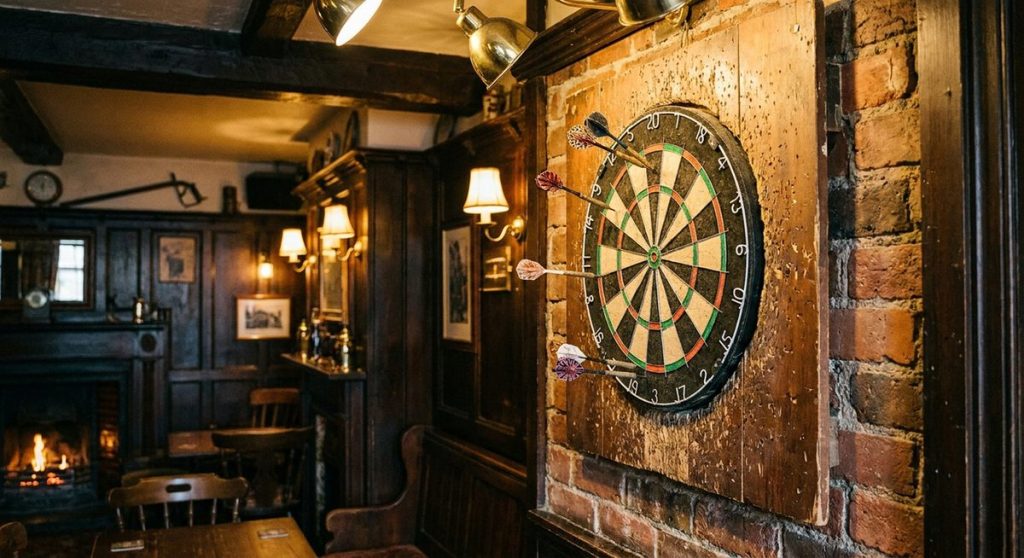
Darts is the only sport I can think of where the venue was also the training ground. You didn’t go to a club to practise and then go to a pub to watch, the pub was where it happened, from the first dart to the last. That matters more than people realise when they try to explain why darts embedded itself so deeply into British working-class life and why, when television got hold of it, the whole thing briefly became enormous.
This isn’t a defence of darts. It doesn’t need one. It’s a record of what actually happened.
Where Darts Comes From
The origins are genuinely murky. Most accounts place the standardisation of the modern dartboard, the treble ring, the bullseye scoring, the wire divisions, somewhere in the late nineteenth century, with Brian Gamlin of Bury in Lancashire often credited with the numbering layout around 1896. Whether that’s entirely accurate is disputed. What isn’t disputed is the geography: the game took root in the pub culture of northern England and the Midlands and stayed there for decades.
By the early twentieth century, darts was a fixture in working men’s clubs across Yorkshire, Lancashire, the East Midlands, and the Black Country. These weren’t recreational venues in the polite sense. They were the social infrastructure of industrial communities, places where miners and steelworkers and factory hands went after shifts. Darts fitted. It required precision and concentration, could be played competitively or casually, cost almost nothing to participate in, and lived naturally alongside a pint. The sport and the setting were inseparable.
The British Darts Organisation was founded in 1973 by Olly Croft, partly to create a national structure out of what had been a largely regional, county-level game. That was the institutional beginning. The cultural one had been building for about eighty years before Croft got involved.
The 1970s boom was real. The game had been present in British pubs throughout the postwar decades, but the combination of working men’s club culture reaching its peak, the introduction of national television coverage, and the BDO providing a proper competitive ladder accelerated everything. By the mid-1970s, darts was one of the most-played recreational sports in the country, not watched, played. Millions of people were throwing darts in pubs every week.
Why the BBC Made It
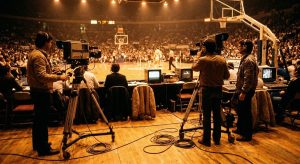
In 1972, Yorkshire Television broadcast Indoor League, hosted by Fred Trueman, which covered pub games including darts. It wasn’t the first televised darts, but it was the moment broadcasters recognised what they had. A game that was visually legible on a small screen, produced natural tension on almost every throw, had clear scoring that viewers could follow at home, and featured players who looked like people from the audience. That last point is not trivial.
The Embassy World Professional Darts Championship launched in 1978 at the Heart of the Midlands club in Nottingham. The BBC covered it. The format was straightforward: best of sets, building to a final. Leighton Rees won it that year, beating John Lowe in a final still played in legs. Eric Bristow, then twenty, won his first title two years later.
The audiences grew quickly. By the early 1980s, the World Championship final was pulling figures that put it alongside major sporting events. The 1983 final between Bristow and Keith Deller drew over eight million viewers on BBC Two. For a sport whose home was still primarily the pub and the working men’s club, that reach was extraordinary.
The BBC didn’t sanitise the game for television. That’s the key thing. Bristow drinking lager at the oche was on screen. The crowds at Jollees Cabaret Club in Stoke and later at the Lakeside Country Club were loud, largely male, definitely not quiet. The BBC broadcast it more or less as it was, and that authenticity was exactly why it worked.
Class, Geography and the Game’s Natural Habitat
Darts was never going to be a posh sport. Not then, not now. The question is whether that’s a problem, and it isn’t. It’s a description.
The game’s geography tells you most of what you need to know. The strongest county associations in the BDO era were in Yorkshire, Lancashire, the Midlands, and the northeast. The London circuit was competitive. Scotland produced some fine players. But the heartland was northern and midlands working-class England, and that wasn’t coincidence. It was the direct result of where the infrastructure existed. Pub leagues, working men’s clubs, miners’ welfare institutes. These were the institutions that produced the player base.
The sporting press had a complicated relationship with this. Darts got genuine coverage during the peak BBC years, newspaper column inches, television guides treating the World Championship as a major event, but there was always an undercurrent of condescension. The players smoked. The crowds drank. The venues weren’t Wimbledon. None of this made darts less skilful, less competitive, or less genuinely difficult to play at the top level. The condescension said more about British class attitudes than it did about the sport.
Working-class sport in Britain has always had to justify itself to an audience that considers participation self-evidently legitimate for certain sports and not others. Darts never bothered justifying itself. It just kept going.
The Embassy Years: When Darts Was Mainstream
The Embassy cigarette sponsorship ran from 1978 to 2003. Twenty-six years. That’s a long time for a tobacco company to back a sport, and the financial relationship shaped everything: prize money, television slots, the profile of the event itself.
By the mid-1980s, the Embassy World Championship had settled at the Lakeside Country Club in Frimley Green, Surrey, where it stayed until 2019. The prize money increased steadily: £3,000 for the champion in 1978, rising to £36,000 by the mid-1990s before the PDC’s breakaway pulled the top earners in a different direction.
Bristow dominated the 1980s, five world titles between 1980 and 1986. Then John Lowe won in 1987, Bob Anderson in 1988 and Jocky Wilson in 1989. Phil Taylor won his first BDO world title in 1990, then his second in 1992, and in 1993 broke away with the fifteen other players who had founded the WDC (later PDC) the year before. The loss of Taylor was the moment the BDO’s trajectory bent permanently downward, even if it took another decade for the full scale of that damage to become visible.
An ITV slot through parts of the early 1990s kept the BDO World Championship in mainstream viewing after the BBC relationship cooled. The audiences were smaller than the BBC peak years but still substantial. Darts was still, just about, a mainstream British sport.
The Split and the Slow Decline of the BDO’s Cultural Reach
In 1993, sixteen of the world’s top players, including Taylor, Dennis Priestley, and Rod Harrington, broke away from the BDO behind the World Darts Council, which they had founded the year before. The BDO banned them, and the players went to court. The legal dispute ran for years and ended in a settlement that allowed both organisations to run separate world championships.
The split wasn’t just organisational. It was a split in the sport’s culture. The WDC/PDC model was explicitly commercial: bigger prize money, more events, a touring circuit that resembled professional sport in the conventional sense. The BDO retained the Lakeside World Championship and the grassroots county structure, but lost the financial firepower to compete for top talent.
The quality gap between the two organisations widened through the late 1990s and accelerated after Sky Sports picked up PDC events. Sky’s coverage was louder and more theatrical, and the players backing it were demonstrably better. Phil Taylor won sixteen world titles over his career. The BDO’s best players in the 2000s were talented, but the gap to the PDC elite was plain to anyone watching both.
Television coverage of the BDO World Championship declined progressively. Channel 4 picked it up after ITV dropped it, then BBC Two returned for a period, but the slot moved earlier and audiences thinned. The Embassy sponsorship ended in 2003 following restrictions on tobacco advertising. Prize money stagnated. By the 2010s, the BDO World Championship at Lakeside was a nostalgia event with real competitive darts still inside it, but it was no longer where the sport’s centre of gravity sat.
The BDO went into liquidation in September 2020. Its World Championship had already left Lakeside for the Indigo at The O2 that January: a late attempt at reinvention that wasn’t going to work. It didn’t. The organisation that had structured British grassroots darts for nearly fifty years was gone.
What Darts Culture Looks Like Today
The PDC has the television deals, the prize money, the best players, and the crowds. The World Darts Championship at Alexandra Palace has become one of the most distinctive sporting events in the British calendar: fancy dress, noise, a genuine carnival atmosphere the PDC has cultivated deliberately. It works as spectacle. The darts is genuinely excellent.
Something is different, though. Not worse, necessarily. Just different.
Lakeside held 1,170 people for darts. You were close to the stage. The players walked through the crowd to reach the oche. There was no corridor, no security perimeter, no theatrical entrance tunnel. It was intimate in a way that Alexandra Palace, with around 3,200 a session in the West Hall and production values borrowed from a pop concert, simply isn’t. The BDO format kept darts connected to its pub-and-club origins even while putting it on television. The PDC format is unambiguously a show, and a good one, but the thread back to the working men’s club circuit has loosened considerably.
Pub darts is still enormous. Millions of people play in leagues every week. The grassroots game didn’t vanish when the BDO did: county associations still function, the Darts Regulation Authority absorbed the BDO’s administrative role, and local competitive darts continues much as it always has. That foundation isn’t gone.
But the specific cultural moment, when British working-class sport produced its own mainstream television phenomenon, with players who came straight out of pub leagues and audiences who watched because they played the same game themselves, that was a particular thing. It lasted from roughly 1978 to roughly 2003. Twenty-six years. The Embassy years. The BDO years. The Lakeside years.
Worth remembering accurately, rather than romanticising into something it wasn’t or dismissing as something that doesn’t matter. It mattered. It still does.