Ten World Titles
Start with the number, because the number is extraordinary. Ten. Ten BDO Women’s World Championship titles, won across fifteen years. No other player, men’s or women’s, won ten titles at the BDO World Championship. Phil Taylor won more world titles in total, sixteen, but fourteen of them came at the PDC’s championship and only two in the BDO. Gulliver won ten out of a possible sixteen editions of her championship. More than half. As a proportion of available titles, there is no equivalent in either code of the game.
The years: 2001, 2002, 2003, 2004, 2005, 2006, 2007, 2010, 2011, 2016. Seven of those came consecutively. The BDO Women’s World Championship began in 2001 and Gulliver won it immediately, beating Mandy Solomons in the inaugural final. She then kept winning until Anastasia Dobromyslova stopped her in 2008. Three years of other champions followed. Gulliver came back and won twice more. Then she came back again in 2016, nine years after her seventh consecutive title, and won again. She was 46 years old.
That last title matters. Anyone can dominate when they are young and at peak fitness. Coming back at 46 and winning a world championship: that is something different. It speaks to character as much as ability.
What Made Her Different
Catrina Elizabeth Gulliver, born in Southam, Warwickshire on 30 November 1969, was not the most naturally gifted thrower of her generation in purely mechanical terms. She would probably accept that herself. What she had was something harder to manufacture: composure. The kind that does not slip under pressure, not in a world final, not with everything on the line and a packed Lakeside crowd watching every dart.
Her technique was compact and repeatable. No flourishes. No excess movement. She set up on the oche the same way every time, threw the same way every time, and trusted that consistency to carry her through when matches got tight. It usually did.
The double game was where she was most dangerous. Gulliver closed out legs cleanly and did not leave herself stranded on awkward numbers. That sounds straightforward: it is extraordinarily difficult to do under finals pressure, repeatedly, across a decade and a half. Opponents who watched her in full flow remarked on how rarely she seemed rattled. She did not betray anxiety. She stepped up, threw, and more often than not the dart landed where she wanted it.
She was awarded the MBE in the 2013 Birthday Honours for services to darts and to charitable fundraising. That recognition came twelve years into a career that had already rewritten the record books. It felt overdue, which is the usual situation with darts honours.
The Rivalry with Hoenselaar
Francis Hoenselaar of the Netherlands reached six BDO Women’s World Championship finals. She won one of them. The other five she lost: all five to Trina Gulliver, in 2002, 2004, 2005, 2006 and 2007.
Think about what it takes to reach a world championship final five times and lose each time to the same person. Hoenselaar could not have lacked ability. You do not reach that many finals without serious quality. She was consistently the second-best player at Lakeside during the height of Gulliver’s dominance, and in another era she would have won multiple titles. In this era, she ran into a wall.
The 2007 final was the closest. Gulliver won it on a sudden-death leg in the deciding set. Hoenselaar was the better player in patches. It made no difference. Gulliver won.
In 2009, Hoenselaar finally got through. She beat Gulliver 2–1 in the final and became the first Dutch women’s world champion. After five finals losses, the victory felt significant: not as an upset, because Hoenselaar was always good enough, but as the moment the wall finally came down. It was the defining upset of the women’s BDO era.
The following year, 2010, Gulliver took the title back, beating Rhian Edwards 2–0 in the final, twelve months after her one defeat by Hoenselaar.
Six finals between them. Gulliver five, Hoenselaar one. The scoreline does not reflect how hard Hoenselaar made Gulliver work for most of those titles. Rivals shape careers. Hoenselaar shaped Gulliver’s more than anyone else.
After the Winning
Post-dominance careers in darts often tail off quietly. Gulliver’s did not. She kept competing. Her 2016 title came five years after her ninth, and she remained a presence on the women’s circuit into her late forties. That alone sets her apart from players who stepped back once the titles stopped coming routinely.
Beyond competing, she moved into coaching. Gulliver completed the official PDPA 1st 4 Sport coaching and UK Coaching programme, qualifying as an official PDPA coach. That progression, from champion to certified coach, is not common. It demonstrates a level of investment in the sport that goes past personal achievement into something broader.
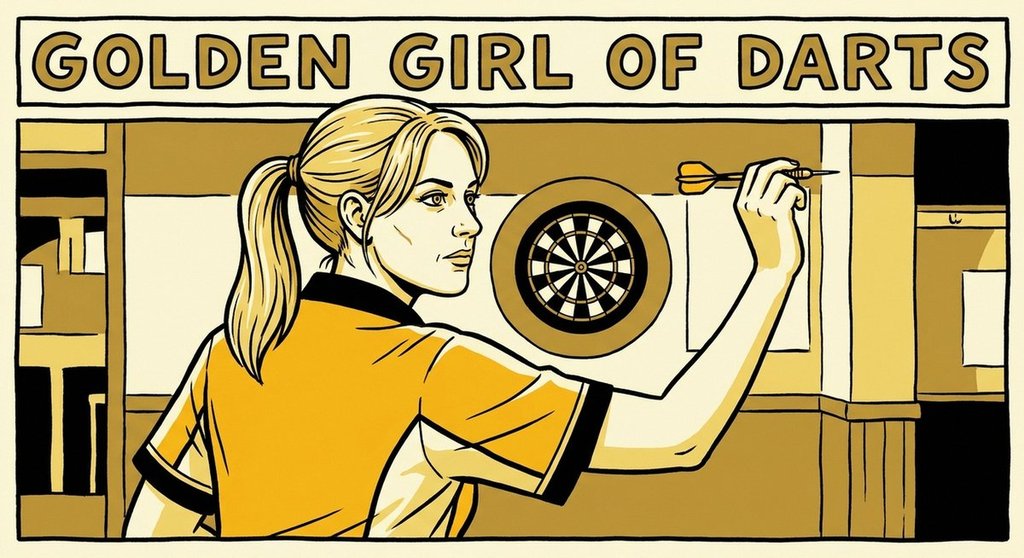
She has been an ambassador for women’s darts throughout. Her autobiography, “Golden Girl”, that is her nickname, the Golden Girl, published in the mid-2000s, gave a profile to women’s darts at a point when it was still largely ignored by the mainstream sporting press. Whether that shifted attitudes is debatable. It created a record.
Gulliver continued to appear at darts events long after her final title. She is part of the institutional memory of the women’s game. A player whose name is referenced whenever the conversation turns to what the BDO produced at its best. That kind of legacy does not happen automatically. You build it by being consistently excellent over a very long time.
Her Place in the Record Books
Ten world titles. There is no equivalent in either the men’s or women’s game when measured as proportion of titles won. Phil Taylor’s sixteen world titles are the standard benchmark, but fourteen of them came at the PDC’s championship, which has run since 1994, and Taylor was competing across thirty-plus years. Taylor won sixteen from thirty-plus editions. Gulliver won ten from sixteen. Proportionally, it is not close.
The men’s BDO record stands at five titles, all of them Eric Bristow’s, won between 1980 and 1986. Raymond van Barneveld came closest with four, between 1998 and 2005. Both are rightly considered among the greatest BDO players of the Lakeside era. Neither came close to ten.
Context matters here. The women’s BDO championship ran from 2001 to 2020, twenty editions in total. Gulliver entered from the start and remained competitive across every credible era of the event. That is not luck of draw or era: that is quality sustained across time.
What Gulliver built at Frimley Green was the definitive record of the BDO women’s game. Whether the sport acknowledges it proportionally is a different question. The record stands regardless. Ten titles, one oche, one player from Southam, Warwickshire, who showed up and won more than anyone thought possible, and then came back and won again.