Five titles. And then, rather abruptly, no more.
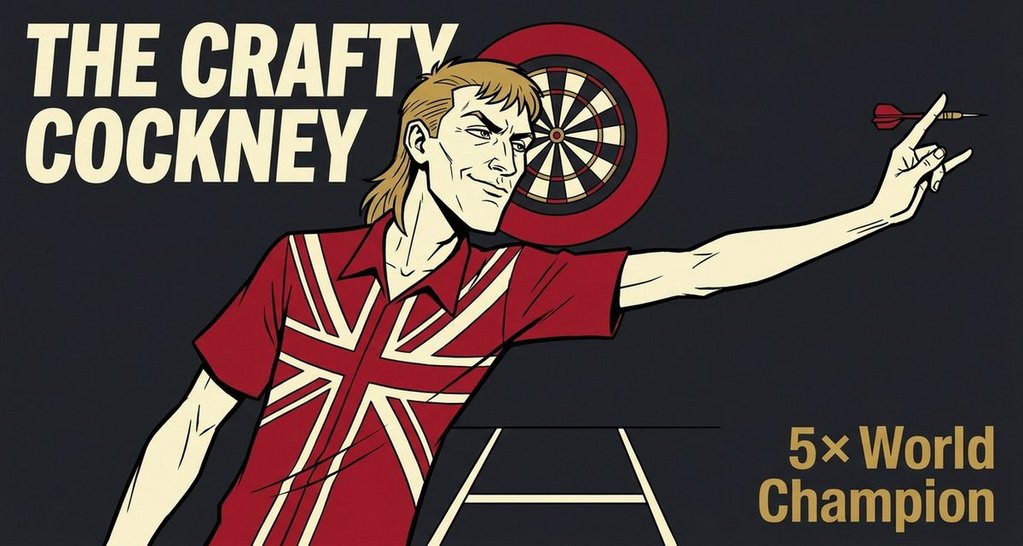
Eric Bristow won the BDO World Darts Championship in 1980, 1981, 1984, 1985, and 1986. Five times world champion across seven years, which tells you something about how total his dominance was, and also how early it ended. He was 28 when he won that last one. Most players at 28 are still trying to work out what they’re capable of. Bristow had already done the lot.
He called himself the Crafty Cockney. The nickname stuck because it fit. He was from Hackney originally, raised in Stoke Newington, and he played with a swagger that was entirely genuine rather than manufactured. When Bristow stood at the oche in the early ’80s, he knew he was the best player in the room. So did everyone else.
Five World Titles
The 1980 championship was his first, and it set the tone. Bristow wasn’t a player who crept up on you gradually. He arrived and immediately looked like someone who expected to win. He backed that up against Bobby George in that first final, then retained it in 1981 against John Lowe.
After Jocky Wilson in 1982 and Keith Deller in 1983 interrupted things, Bristow came back with three consecutive titles: 1984 over Dave Whitcombe, 1985 over Lowe again, 1986 over Whitcombe again. That three-in-a-row was the peak. He was world number one for most of the period between 1980 and 1987, and there wasn’t much of an argument about it.
What made him genuinely special, beyond the titles, was the temperament. He did not freeze. He didn’t appear to feel pressure in the way other players visibly did. Big legs, tight finishes, last-dart situations: Bristow treated them as confirmation of what he already knew about himself. Among the greatest BDO players of the Lakeside era, his mental strength stands apart even now.
The scoring was precise and the doubles were reliable in a way that looks straightforward until you try to replicate it under any kind of pressure. He averaged consistently well above what was considered competitive at the time. His peers knew they were usually playing for second place.
The Decline: Focal Dystonia
It started in November 1986, at the Swedish Open. Bristow found he couldn’t release the dart properly. Not every throw, sometimes it was fine, but often enough that something was clearly wrong. He’d throw and the dart would go where it shouldn’t. He’d stand there and not be able to let go of it at all.
This was dartitis. The word sounds almost comic, like something you’d invent to excuse a bad night. It isn’t. It’s a form of focal dystonia: a neurological condition where the brain’s signals to the muscles involved in a very specific, highly practised movement become disrupted. Golfers get it with putting. Baseball players get it throwing to first base. Darts players get it at the oche, when the throw that’s been automatic for twenty years suddenly isn’t.
Bristow fought it for years. He kept playing, kept entering tournaments, tried adjusting his grip and his stance and his pre-throw routine. There were stretches where it looked like he’d found a way through, and then it would come back. He reached the 1987 and 1988 World Championship finals, which is remarkable given what he was dealing with, but couldn’t win either. Bristow at 38 was not the same player. That much is plain.
Nobody quite knew what to do with that information at the time. Focal dystonia wasn’t well understood in sports science circles in the late ’80s, let alone in darts. Bristow wasn’t getting much sympathy either, partly because he’d always projected such confidence that watching him struggle felt strange, almost impossible to process. The sport moved on. He did his best to move with it.
What He Built
Whatever else you want to say about Eric Bristow, the Phil Taylor story is extraordinary.
Bristow met Taylor in the mid-1980s, when Taylor was a young player from Stoke-on-Trent with obvious talent and no real path to developing it professionally. Bristow backed him financially, reportedly around £10,000 of his own money, to cover flights, hotels, entry fees for tournaments in America, Canada and across Europe. He told Taylor to quit his factory job and commit to darts properly. Taylor did.
The return on that investment was not straightforward for Bristow personally. In the 1990 World Championship final, Taylor, a 125/1 outsider, beat his mentor 6–1. Bristow, by then deep into his dartitis years, was on the other side of the biggest upset the sport had seen. Taylor would go on to win 16 world titles. The student didn’t just surpass the teacher; he eventually made the teacher look like a stepping stone, which can’t have been easy to sit with.
Taylor was clear about it after Bristow died, though. “Eric was like a brother to me. I loved him. Quite simply I owe him everything.” You can read Phil Taylor’s BDO years and trace directly how Bristow’s early sponsorship shaped the foundation of what became the most dominant career in the sport’s history.
Beyond Taylor, Bristow’s impact on British darts culture was significant simply because of when he was dominant. The BBC covered darts heavily in the early ’80s, and Bristow was the face of the sport during that period. Recognisable to people who didn’t follow darts at all, which mattered for the sport’s growth and its working-class credibility. He wore that visibility comfortably. Some players shrink from it. He didn’t.
The Controversy
In November 2016, as reports emerged of widespread child sexual abuse carried out by football coaches, the Barry Bennell case being central, Bristow posted a series of tweets that caused immediate and serious uproar.
He suggested the victims, who had spoken publicly about abuse they’d suffered as boys, should have gone back and “sorted out” their abusers when they were older. He called them “wimps.” He also made comments that were widely described as homophobic, linking homosexuality with paedophilia in a way that was offensive and factually unfounded. The tweets drew fierce criticism from abuse survivors, commentators, and sports figures.
Sky Sports sacked him. He was removed from a planned appearance at a Newcastle United event. He apologised, saying he now understood he’d got it badly wrong, but the damage was done.
His MBE, awarded in 1989, was not formally withdrawn. There were calls for a review but no action was taken before his death. The tweets remain the final significant public act most people associate with him, which is its own kind of verdict.
The Legacy Now
Eric Bristow died on 5 April 2018, aged 60, after suffering a heart attack at a Premier League Darts event in Liverpool. The tributes were genuine and numerous. Phil Taylor’s was the most quoted. The sport stopped for a moment, which it should have done.
The honest account of his legacy sits with two things in tension and neither cancels the other out.
He was a genuinely exceptional darts player. Five world titles, a period of dominance that nobody in the BDO era matched until Phil Taylor made dominance look different entirely, a mental strength that set the standard for what top-level competitive darts could look like. He took the sport seriously as a craft. He backed a young player with his own money when he didn’t have to, and that player became the greatest the game has produced. These things are real.
The 2016 controversy is also real. What he wrote was harmful and wrong, and the people it hurt most were abuse survivors who deserved better than being called wimps by a former sporting celebrity. Bristow’s apology was accepted by some and not by others, which is fair enough. He didn’t get to do much after that to change the narrative.
So the legacy is complicated. Probably more complicated than most players from his era. But the titles are the titles, and five of them in seven years at the highest level of the sport is not something you dismiss. You hold both things. That’s the honest position.