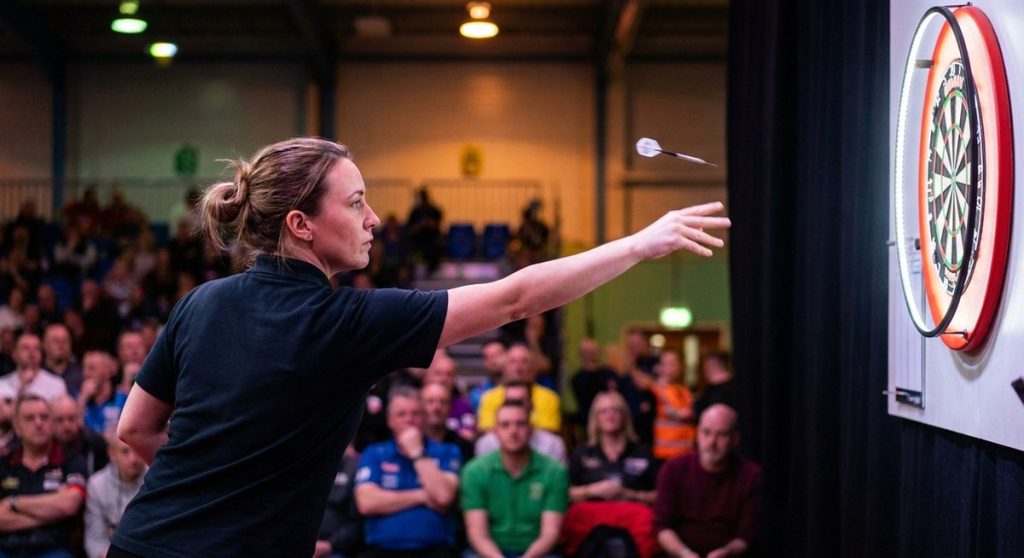
The BDO World Darts Championship had run for 23 years, fifteen of them at Frimley Green, before the women got their place in it. When they finally did, in 2001, some people in the darts world treated it as a footnote. A curtain-raiser. Something to fill the programme before the blokes got on. That was wrong then. History made it look worse.
How It Started
The BDO introduced the Women’s World Championship in 2001, running it alongside the men’s event at the Lakeside Country Club. It was long overdue. Women had been competing seriously in darts for years, the British Darts Organisation itself had run women’s events since the 1970s, but a world title at Lakeside was a different level of recognition entirely.
The inaugural champion was Trina Gulliver from Warwickshire. She beat Mandy Solomons in the final and walked away with £4,000. The men’s winner that year, John Walton, collected £46,000. You can draw your own conclusions about what the BDO thought the two championships were worth.
Still, it was a start. And Gulliver made it count immediately.
The Gulliver Years
Trina Gulliver won seven consecutive titles from 2001 to 2007. Seven. In a row. No other player in BDO women’s history came close to that sequence, and very few in the sport at any level can point to that kind of sustained dominance across an entire decade.
What made her exceptional wasn’t just the winning. It was the consistency of her game under pressure. Gulliver was composed on the oche in a way that made finals look almost routine, which they weren’t, because Francis Hoenselaar kept making her earn every single one. Hoenselaar reached five of those finals and lost every one. 2002, 2004, 2005, 2006, 2007. Five losses to the same opponent, in the same final, at the same venue. Most players would have cracked long before the fifth attempt. Hoenselaar kept coming back.
Gulliver’s game was built on precision and nerve. She didn’t have the raw power average of some players who came later, but she knew when to close. Double-top under pressure, last dart in the final leg. That was her territory. She owned it.
After the 2007 championship, Anastasia Dobromyslova broke the sequence. Gulliver then won again in 2010 and 2011, and one final time in 2016. That’s ten world titles in total. A record that stands across both the men’s and women’s game in BDO history. Ten. It’s not even close.
The Rest of the Field
The dominant narrative of the Gulliver era is sometimes told as if she competed in a vacuum. She didn’t. The field around her was competitive, and the years after 2007 showed what happened when she had serious challengers who could actually win.
Francis Hoenselaar finally got her title in 2009, defeating Gulliver in the final. She remains the only Dutch woman to have won a world darts championship. Six finals, one title. The record looks brutal on paper, but anyone who watched her play knows the losses weren’t embarrassments. She was just repeatedly running into someone who was a little better on the day.
Anastasia Dobromyslova won in 2008, then again in 2012 and 2013. Three titles. She was the first player from outside Britain to win the championship. Her 2008 win over Gulliver at Lakeside, 2–0, was emphatic. She was 23 years old. The women’s game had found a new voice from an entirely unexpected direction.
Lisa Ashton was the dominant force of the mid-2010s. Four titles: 2014, 2015, 2017, 2018. Bolton-born, direct, metronomic. She wasn’t flashy. She didn’t need to be. In the 2015 final she beat Fallon Sherrock 3–1. Sherrock had reached that final after hitting five 180s against Dobromyslova in the semi. A world championship record at the time. The women’s game was producing moments that deserved far more coverage than they were getting.
See All BDO World Champions for the complete list of every title holder, men’s and women’s.
Prize Money and What the Women Were Worth
This is the part that doesn’t reflect well on anyone in charge.
In 2001, the women’s winner took home £4,000. In 2007 it was still £6,000, and it took until 2011 to reach £10,000 and until 2014 to reach £12,000. Those numbers look modest on their own and worse next to the men’s side: the men’s winner collected £46,000 in 2001, £70,000 in 2007 and £100,000 by 2009, when the BDO’s total prize fund passed £300,000.
In the final year, 2020, Wayne Warren won the men’s title and received £23,000: already a historic low, a sign of how badly the BDO’s finances had collapsed. Mikuru Suzuki, the women’s champion, got £10,000. Same tournament, same week at the Indigo at The O2: more than double the money for one of them.
The gap narrowed over the years, slowly, inconsistently. There was never a moment where the BDO said: these are equal championships, they’ll be treated equally. It was always one rung below. The women played on in the mornings. The prize money reflected that scheduling choice precisely.
It wasn’t unique to darts. But darts was a sport that talked a lot about being a people’s game, a working-class game, a sport where background didn’t matter. The prize money gap made a mockery of that when it suited.
The Final Years and the End
Mikuru Suzuki won in 2019. A 36-year-old from Japan, she became the first Asian champion in the history of the championship, the first from outside Europe entirely. She retained the title in 2020, beating Lisa Ashton 3–0 in the final at what turned out to be the last BDO World Championship ever held.
The BDO went into liquidation in September 2020. It had been coming for years: dwindling sponsorship, players defecting to the PDC, TV deals that never materialised, attendances softening from the Lakeside highs of the early 2000s. The organisation that had run the game for over four decades simply ceased to exist.
For the women’s game, the collapse hit hardest. The BDO Women’s World Championship had been the only world title in the game. The PDC ran nothing equivalent. The WDF eventually stepped in, and women’s darts has continued through new structures, but the continuity broke. The records, the history, the specific atmosphere that the women’s final had built over nineteen years at Frimley Green: gone.
Trina Gulliver’s ten titles stand as the defining mark of that era. The championship started in 2001 with Gulliver collecting £4,000 whilst the men’s winner got more than eleven times as much, and ended in 2020 with Mikuru Suzuki winning a tournament whose prize fund had been slashed days before it started. Quality throughout. Recognition, never quite enough.