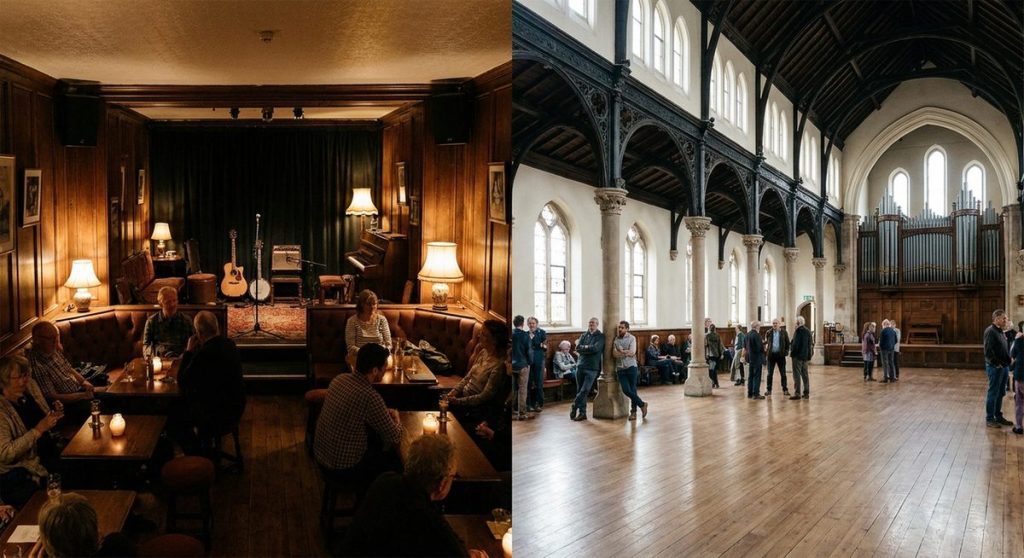
Two Venues, Two Worlds
They both hosted a World Darts Championship. They’ve both had Dutch fans in fancy dress occupying entire rows. And they’ve both been described, at various points, as “the home of darts.” That’s the full list of things Lakeside Country Club and Alexandra Palace have in common.
Everything else, the architecture, the scale, the feel in your chest when you walk in, the sound of the crowd bouncing off walls versus disappearing into rafters, is different. Completely, fundamentally different. Not better-and-worse necessarily, though Graham Priestley does have a view on that. Two distinct sporting experiences wearing the same label.
Lakeside Country Club
Frimley Green, Surrey. January. Cold car park. The queue snaking round the building before the doors open, people in coats clutching programmes, someone’s grandad in a BDO polo shirt he’s worn to this every year since 1994. This is the BDO World Darts Championship.
Lakeside holds 1,170 people for darts. That’s not a misprint. A little over a thousand. In a cabaret room built for dinner-dances and corporate functions, not world championship sport. The stage is low. The oche is close. You can see the players sweat.
The BDO moved here in 1986, having spent the previous seven years at Jollees Cabaret Club in Stoke-on-Trent. They stayed until 2019, thirty-four championships in the same room. The ceiling didn’t get any higher. The crowd didn’t thin out. If anything, Lakeside became more itself over time: more compressed, more claustrophobic in exactly the right way.
The sound in that room is specific. It doesn’t roar, it erupts. When a player hits a big finish, the noise has nowhere to go. It bounces off the walls, off the low ceiling, off the people standing three feet in front of you. In a venue that size, a thousand people feel like five thousand. In the back section during a 2007 semi-final, the announcer could not be heard over the crowd, from eight feet away from the speakers.
It also looks like nowhere else in world sport. No corporate sky boxes. No giant screens dwarfing the action. Just a stage, a pair of players, and a room full of people who’d driven from Hampshire or taken the train from Waterloo and were there because this is what they do every January. The carpet’s a bit tacky. It’s imperfect. That’s the point.
Alexandra Palace
Alexandra Palace opened on 24 May 1873. Sixteen days later it burned down. The Victorians rebuilt it, and it reopened on 1 May 1875, bigger, with water tanks in the corner towers that hadn’t been there before. North London’s answer to Crystal Palace, sitting on a hill in Muswell Hill with views across the city.
The first PDC World Darts Championship ran from 28 December 1993 to 2 January 1994 at the Circus Tavern in Purfleet, Essex, itself a venue that split opinion, though in different ways from Lakeside. It moved to Ally Pally in 2008, and the combination stuck. The tournament expanded, the prize money exploded, and Alexandra Palace became, for better or worse, the face of modern professional darts.
The PDC plays in the West Hall, which holds around 3,200 people per session. That’s nearly three times the Lakeside figure. The stage is bigger, the screens are bigger, the lighting rig takes longer to install than the entire Lakeside setup probably takes to run. It looks like a televised sporting event because it is one, engineered for Sky Sports from the ground up.
And the building itself is something. Walking into Ally Pally for the first time, you notice the ceiling before anything else. It’s vast: the kind of Victorian-era civic ambition that assumes space is a statement. The PDC leans into it. The production values fill the room. There’s a reason people make the pilgrimage from the Netherlands, Germany, Australia. It’s a spectacle as much as a sporting event.
The Crowd and Atmosphere
Both venues get the Dutch contingent. Orange shirts, Viking hats, someone dressed as a windmill. Darts crowds are darts crowds in that sense. The fancy dress is nonnegotiable, the beer is essential, the noise is consistent. But the experience of being inside that noise is entirely different.
At Lakeside’s atmosphere, the crowd is intimate to the point of intrusion. The players can hear individual voices. A heckle lands differently at thirty feet than at three hundred. There’s a communal warmth that comes from being packed tightly into a room with people who’ve come a long way and know why they’re here. It isn’t polished. It isn’t designed. It’s organic in the way things get when they’ve been doing the same thing for thirty years.
Ally Pally is louder by absolute measure. When three thousand people get going, the decibels are simply higher. But the sound disperses upward into that Victorian ceiling, and the sheer scale of the room absorbs some of what makes a darts crowd feel electric. You’re watching an event. At Lakeside, you’re inside one.
Which is louder for its size? Lakeside. Easily. The crowd-to-noise ratio at Frimley Green is something engineers probably couldn’t explain. Put 1,170 people in a room built for cabaret and give them a World Championship and there’s no scientific reason it shouldn’t be deafening. It was.
Which Matters More to Darts History
This is where it gets honest rather than sentimental.
Lakeside has the years. Thirty-four of them, 1986 to 2019. Bristow winning there. Lowe, Rees, Fordham, Barneveld in the era when he still came back for the BDO. A tournament that defined a generation of British working-class sporting culture and did it quietly, in a Surrey cabaret room, without anyone from Sky Sports calling it iconic until it was nearly over.
Ally Pally has the money and the players. The PDC prize fund for their 2015 World Championship was £1.25 million, with £250,000 to the winner. The BDO’s entire men’s pool that year was £300,000. When Phil Taylor, Adrian Lewis, Gary Anderson and Michael van Gerwen were the best players in the world, they were playing at Alexandra Palace. That’s just fact.
The BDO had more tradition. The PDC had more talent, more money, and, after 2008, the better venue by most measurable criteria. Both are essential to the story of how darts got from pub game to professional sport. You can’t tell it properly without Lakeside. You can’t tell it properly without Ally Pally either.
On atmosphere alone, the cabaret room wins. It is easy to see why everyone else queues for the hill.